
Unusual Lawn Plant Seeds from around the World

Plus, its fragrant needles add a delightful scent to your home or garden. Use it as a stunning centerpiece for your holiday decor or as a year-round landscape specimen. Grow some and enjoy the beauty and tranquility of this wonderful tree.
It can grow 50-80 feet tall, with a spread of 10-15 feet. Best for zones 5-8.
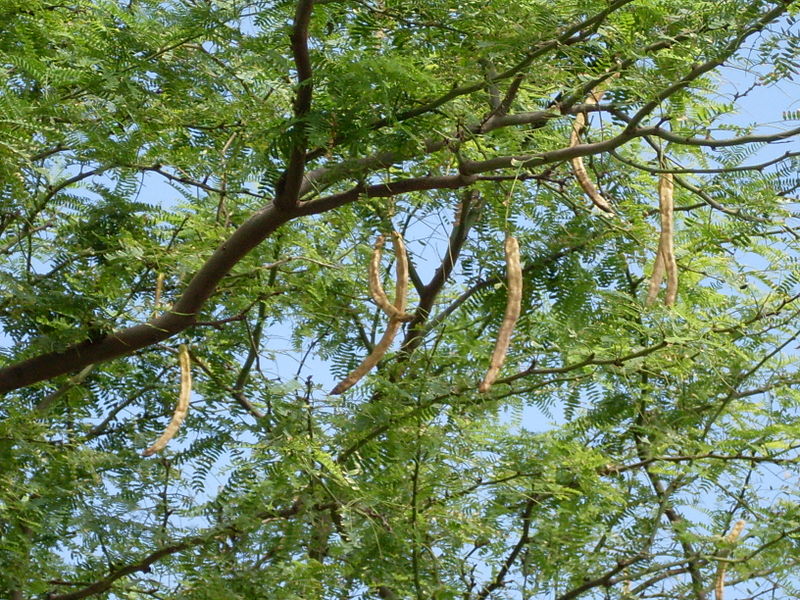
The leaves can be used for forage. Providing good bee pasturage also, nectar from mesquite yields a superior honey. The wood is used for parquet floors, furniture, and turnery items, fencepost, pilings, as a substrate for producing single-cell protein, but most of all for fuel. Toasted seeds are added to coffee.
Bark, rich in tannin, is used for roofing in Colombia. The gum forms an adhesive mucilage, used as an emulsifying agent. Gum is used in confectionary and mending pottery. Roots contain 6-7% tannin, which might discourage Rhizobia. It is valued for wood and often used for cooking. It displays yellow blossoms and bean pods that are valuable to wildlife. Tool handles, plaque wood, fenceposts and aromatic charcoal for barbecuing are made from mesquite. Despite its sweetness, mesquite flour which is produced by grinding whole pods, has been found in medicinal research to be extremely effective in controlling blood sugar levels in people with diabetes. This is an excellent desert species for low-maintenance desert windbreaks and re-vegetation. Growth rate is faster when supplemental water is used.

According to WebMD, the berries and flowers of elderberry are packed with antioxidants and vitamins that may boost your immune system. They could help tame inflammation, lessen stress, and help protect your heart, too. Some experts recommend elderberry to help prevent and ease cold and flu symptoms. It’s also been used as a treatment for: Constipation, joint and muscle pain, infections that affect how you breathe, headaches, fever, kidney problems, epilepsy, minor skin conditions, stress, HIV and AIDS
It is closely related to the European Sambucus nigra. Some authors treat it as conspecific, under the name Sambucus nigra subsp. canadensis. The primary difference is the European variety is more tree like, where the American variety is more shrublike, the flowers, fruits and uses are almost identical. Some authorities consider this plant to be a subspecies or variety of Sambucus nigra instead of a separate species.
Elderberry erupts with large, lacey sprays of white blossom clusters in June. As the flowers continue to bloom, they fill in to create large umbels and exude a delicate citrusy fragrance, inviting myriads of little pollinators to come visit. Flowers are replaced by succulent, burgundy berries that darken to a rich black-purple once they are ripe. Bowed branches drape and 'water fountain' from the center, providing dense shelter for nesting birds. The foliage turns a lovely burnished yellow in the fall. Various studies reported in food and horticulture scientific journals report that American elderberry as well as the European elder contain antioxidants and have anti-inflammatory and anti-viral properties. According to the USDA, raw elderberry juice is a good source of iron and potassium and vitamins A, B6 and C.
Elderberry plants are easy to grow and can be grown from cuttings or potted plants. They prefer moist, fertile soil and full sun, but can tolerate partial shade and some drought. They can be grown in zones 3-9.
Seeds need 60 days cold stratification before sowing.

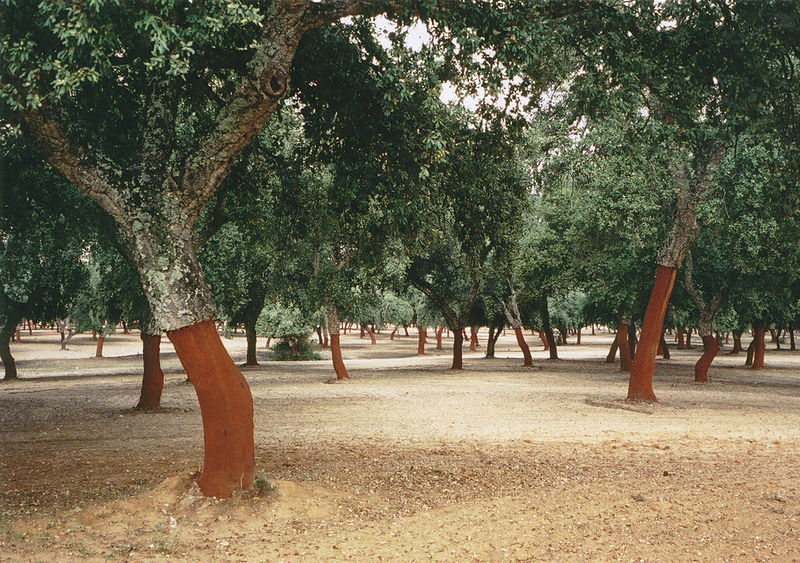
It is the primary source of cork for wine bottle stoppers and other uses, such as cork flooring. It is native to southwest Europe and northwest Africa.
The tree forms a thick, rugged bark containing high levels of suberin. Over time the cork cambium layer of bark can develop considerable thickness and can be harvested every 9 to 12 years to produce cork. The harvesting of cork does not harm the tree, in fact, no trees are cut down during the harvesting process. Only the bark is extracted, and a new layer of cork regrows, making it a renewable resource.
Cork Oaks are sometimes planted as individual trees, providing a minor income to their owners. The tree is also sometimes cultivated for ornament.
The tree is cultivated in Spain, Portugal, Algeria, Morocco, France, Italy and Tunisia. Cork Oaks are considered to be soil builders and their fruits have been shown to have useful insecticidal properties.
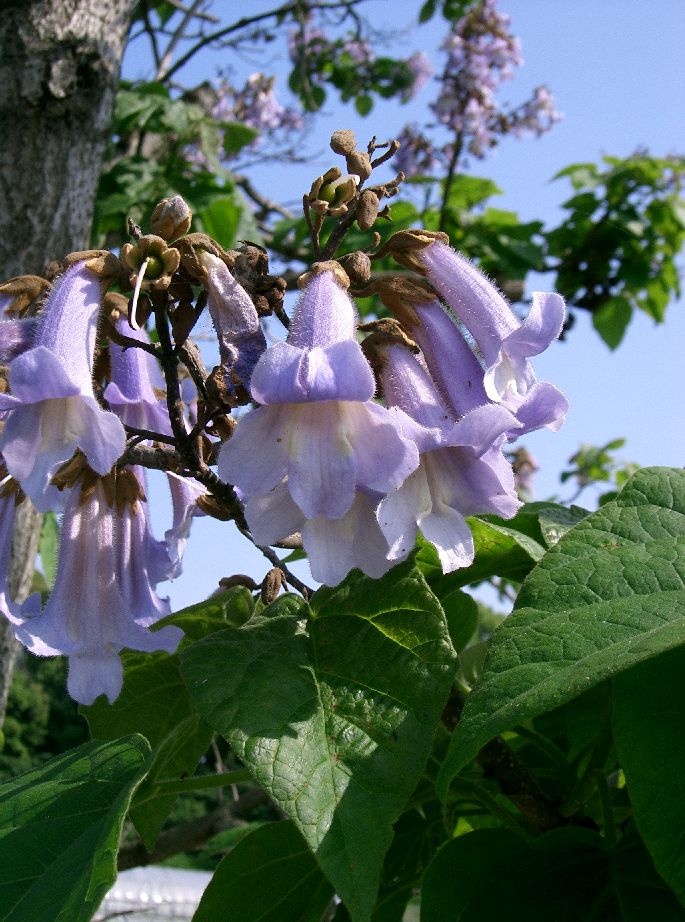
It is an upright to spreading deciduous tree that typically grows to 40’ tall with a rounded crown. It is noted for its profuse bloom of fragrant, tubular, funnel-shaped, pinkish-lavender flowers (to 2" long) with interior dark purple spotting and creamy yellow striping. Flowers appear in spring in clusters (to 14" long) before the foliage. Flower aroma is reminiscent of vanilla. Flowers are edible and are sometimes added to salads.
A wonderful lawn tree that can be grown almost anywhere as it will tolerate extreme temperature ranges from -10 to 110 degrees°F.
Large clusters of fragrant violet flowers in some seasons plus large exotic leaves. Amazing growth rate, a single shoot will often reach up to 8ft in a season.
The wood is easy to work with and suitable for the manufacture of furniture, plywood, moldings, doors and many other uses. The flowers are colorful and beautiful in spring and the trees are green and shady in summer.
Paulownia Trees are drought resistant once established. Their roots tend to go deep into the ground in search of water, rather than on the surface. This makes planting around the tree easy and makes it friendlier to nearby walkways or fixtures. Best for zones 5-9.
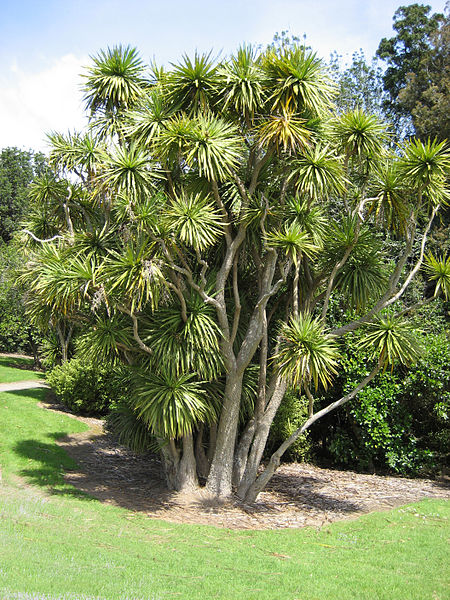
Cabbage Tree tolerates a wide range of soils ranging from wet boggy conditions to dry ones. If grown outdoors, it does best in moist, fertile, organically rich, well-drained soils in full sun to part shade. When grown in containers outside on patios in summer, it can be brought in over the winter or grown indoors year-round as a houseplant. If grown in a container, keep soils consistently moist in summer but reduce moisture indoors in winter and site the plant in bright sunny spots in the home or greenhouse. Also note that container-grown plants rarely flower.
Cabbage Tree has a taproot that needs the root space of a large and deep container for best growth. Young plants consisting of a fountain of grass-like leaves with no trunk are often sold as houseplants. Zones 8-11, or inside plant for colder zones.
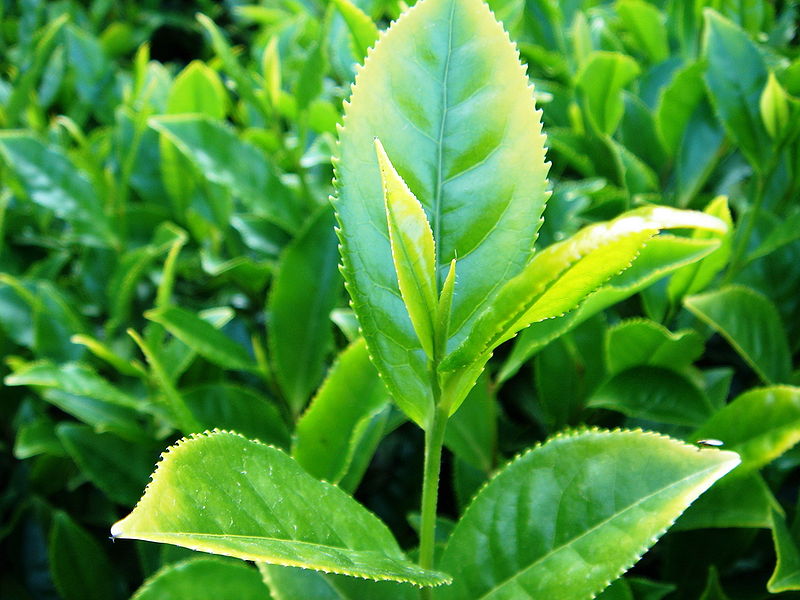
This is the tea produced commercially around the world. The tender, young leaves are used in the process of tea production.
Can be grown in tubs inside, or in cool greenhouses, outdoors in warm climates. Prefers moist, well drained, humus rich, slightly acidic ( 5.5-6.5 )soil. We recommend maintaining a 2-3 inch deep mulch of shredded bark or leaves around base of plant.
Hardy to zone 8, can be grown in zone 7 with protection. To make green tea, pick only the top 3 leaves from new growing tips, spread and dry in the shade for 6-8 hours, then in an open pot, heat ( simmer ) the leaves, stirring frequently for about an hour.
Click here for an informative site on growing and making your own tea. For black tea, you must ferment the leaves. USDA Zones 8 to 11.

These tropical trees will start blooming when they are still quite young. The abundance of rich deep red flowers are produced straight after the new leaves during September and October, but exact flowering times will vary from tree to tree. This irregularity in blooming times is of value to the nectar feeding birds, and ensures a longer feeding season. The flowers produce such copious amounts of nectar that it literally 'weeps' from the flowers.
This is an exceptional ornamental tree for gardens and parks and looks wonderful as part of a larger landscape, or planted singly as a specimen tree. Do not plant it near paved areas or car parks etc, where the dripping nectar could become a problem. When in bloom it will attract a wide variety of birds, animals and insects. The nectar will attract nectar-feeding birds like sunbirds, the nectar will also attract many insects, and therefore insect-eating birds.
Easy to grow in warm frost-free areas, where it remains evergreen and grows surprisingly fast. In colder, dry, inland regions it is slower-growing and deciduous, losing its leaves for a short period in winter or spring. It is semi-hardy to moderate frost if it is planted in a protected part of the garden and young trees are covered in winter, until they are more established. An established tree can withstand minimum winter temperatures of about 24 degrees. It is remarkably hardy in dry regions with poor soil, but for best results in the garden, plant in deep very well-drained soil, to which generous quantities of compost has been added and a dressing of bonemeal. A general purpose granular fertiliser can be used during the growing season. It loves in full sun and will respond well to judicious watering in the garden, especially when young, and during prolonged dry periods.

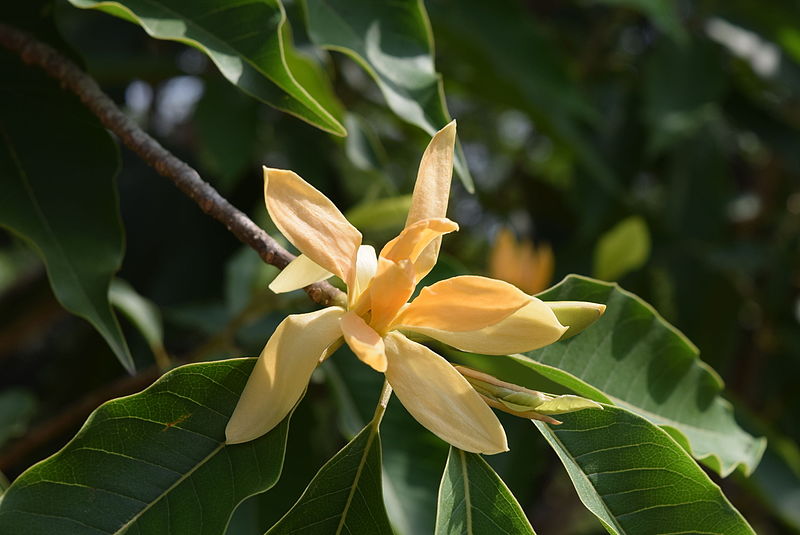
Also known as Champa, Yellow Champa, Golden Campa or Fragrant Champa is highly revered by the followers of Hinduism and Buddhism. They use Michelia flowers during religious ceremonies. Tibetans believe that the Buddha of the next era will find enlightenment under the flower canopy of the champaca tree.
Michelia has several ornamental, commercial and medicinal uses too. For gardeners, it is an excellent choice as a houseplant or as companion plant in landscapes. Commercially, the timber of Michelia is used for almost anything from cabinet-making to firewood and flowers are grown to sell at cut flower shops. The extract from the flowers of Michelia Alba is used in preparation of the famous 'Joy' perfume. Medicinally, the tree has wide applications; the bark is used to prepare tonic, the oil extracted from flowers is used to cure toughs and rheumatism, and for relieving eye troubles and gout.
Michelias are easy to grow and maintain. They love a lot of light and warmth but filtered sunlight. The best location for Michelia is the place where it receives direct and ample sunlight in early morning but partial light for the rest of the day. Suitable for containers, Michelias has shallow and brittle root system. It likes moderate watering in acidic and well-drained soil. As a general rule, water lavishly when the plant is young to allow it to develop good root system. Water mature trees moderately and feed with a general purpose fertilizer during spring. Prune in winter when plant goes dormant.
Outdoors in zone 10 or higher, Michelia can gain a height of 75 feet or more in suitable conditions. The tree bears large leaves that resemble the leaves of Mango tree. The tree booms from May to October and produces abundance of star-shaped flowers that fill the entire surrounding with mesmerizing scent. Flowers are usually golden-yellow, golden-orange and creamy-white.
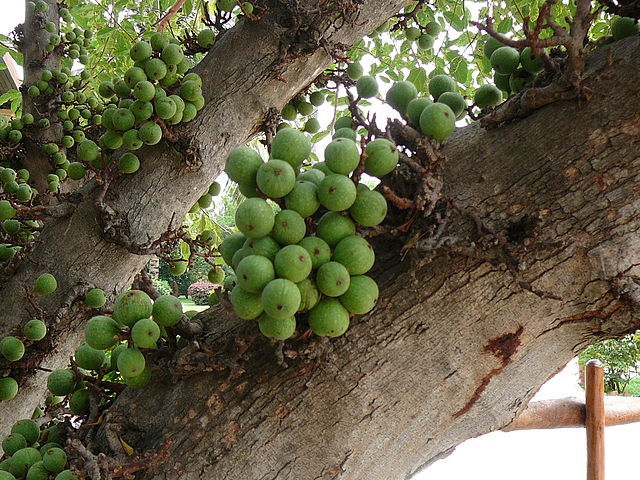
The large, glossy green leaves have attractive, light veins. Ficus lutea is widespread over tropical and southern Africa and found in a variety of forests and woodlands from sea level to 1800 m. It is a very fast growing tree that makes an exceptional ornamental for warm temperate and tropical regions in USDA Zones 10 and above. Easily maintained as a potted plant by occasional grooming of the branches and aerial roots.
A tree of many uses in Africa, the tree is harvested from the wild for local use as a source of medicines, fibres, dyes, latex and potash. Plantations have been established in Florida and SE Asia for the production of latex, which is valued in the pharmaceutical industry. The fruits are edible and eaten in West Africa.
The latex can be used to make a good quality rubber, known as Dahomey rubber, which is where the name orignates.
It also is known for its abundance of fruits borne directly on the branches.
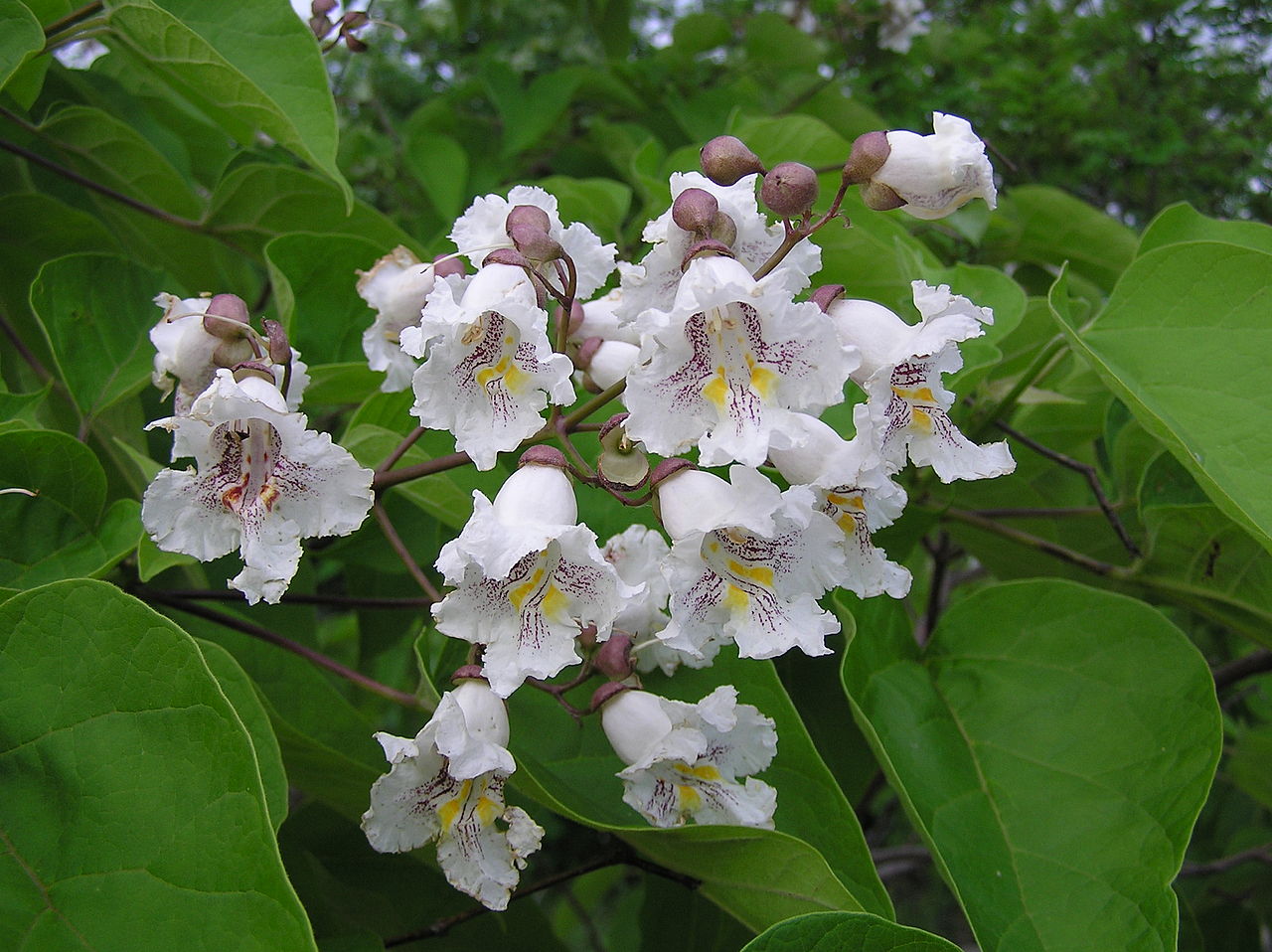
Catalpa has large tropical looking heart-shaped leaves that are up to 8 in long and held oppositely on the stems (often in a whorl with three leaves emerging from the same point along the stem). In spring the southern catalpa produces showy 6-10 inch branching flower clusters (panicles) at the stem tips. The white bell-shaped blossoms are 2 inches in diameter and patterned with small purple spots and two large orange markings at the throat.
The flowers are followed by long slender cigar-shaped pods up to 16 inches in length. The green pods ripen to brown in fall and split to release flat fringed seeds.
Grows in full sun to partial shade. Southern catalpa prefers moist, well drained soils but is adaptable. Hardy for zones 6-10.
Spectacular spring flowers and beautiful bright green foliage make the catalpa one of the South's most distinctive and best loved native trees. Used as an ornamental, accent, specimen, or shade tree. It is a valued ornamental tree with large foliage and showy clusters of flowers in the spring. When grown as a specimen many gardeners drastically cut back the large branches of their catalpas each winter. This radical surgery is called pollarding and the result is a tree with a thick trunk, very compact crown and very large beautiful foliage.
Catalpa also has some limited use in the forest products trade for fence posts, rails and crates.
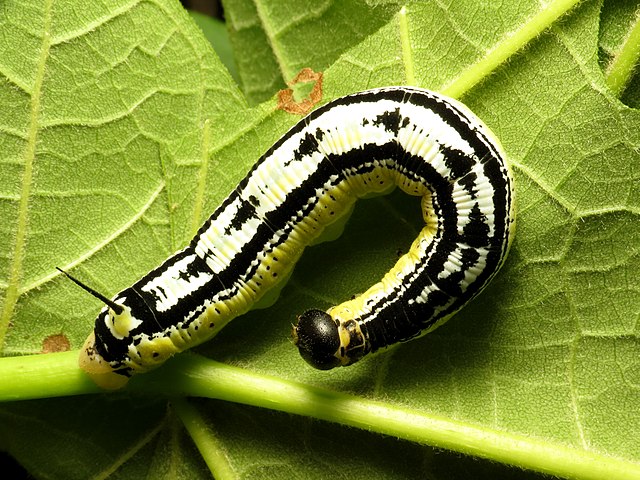
This tree has been widely planted and naturalized outside its native range because it is the host plant for a caterpillar commonly called the catawba worm. These are a popular fishing bait for southern freshwater fish.
All across the American Deep South the catalpa tree is seen, often stripped bare of it's leaves by hungry caterpillars. This means only one thing - it's time to go fishing! The foliage is quickly replaced in a few weeks and the cycle can be repeated several times in a season.
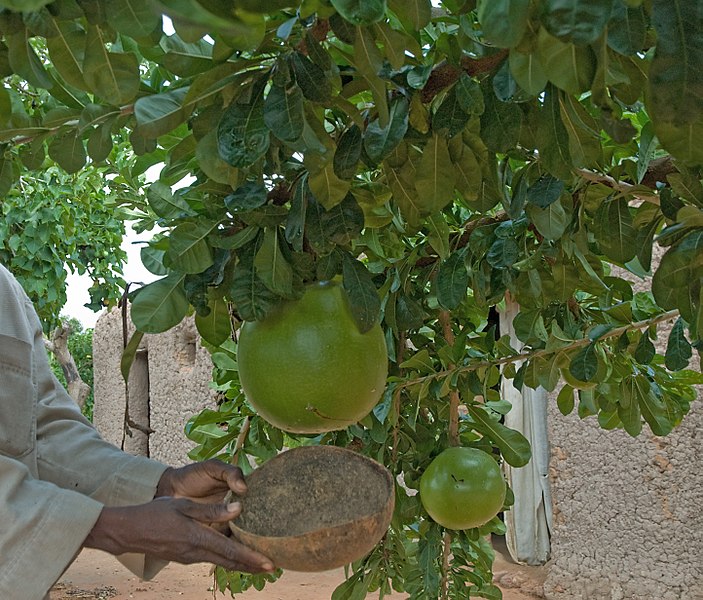
Flowers and fruits are both cauliflorus ( borne directly on the branches and trunk ). Trees typically bloom and fruit throughout the year. It takes about 6 months for a fruit to grow and ripen. Flowers appear singly or in small clusters, have a strong somewhat unpleasant aroma, and are pollinated by bats. Fruits mature to the size of a soccer ball, have a tough woody shell containing a pulpy flesh, and are often hollowed out and used as containers. Fruits are also used to make maracas. Long history of herbal medicinal uses.
A calabash is primarily used to make utensils such as cups, bowls, and basins in rural areas. It can be used for carrying water, or for transporting fish, when fishing. In some Caribbean countries, it is worked, painted, and decorated and turned into items by artisans, and sold to tourists.
As a cup, bowl, or even a water-pipe or "bong", the calabash is considered consistent with the "Ital" or vital lifestyle of not using refined products such as table salt, or modern cooking methods, such as microwave ovens. In Haiti, the plant is called kalbas kouran, literally, "running calabash", and is used to make the sacred rattle emblematic of the Vodou priesthood, called an asson. As such, the plant is highly respected. It is the national tree of St. Lucia. In Cuba, the dried fruit is commonly used as a coffee cup by rural farmers.[5] In Dominican Republic, the plant is called the higüero tree and it is popularly used to make decorative objects and ornaments, though historically it has been used in all sorts of ways. Best grown in zones 11-12.
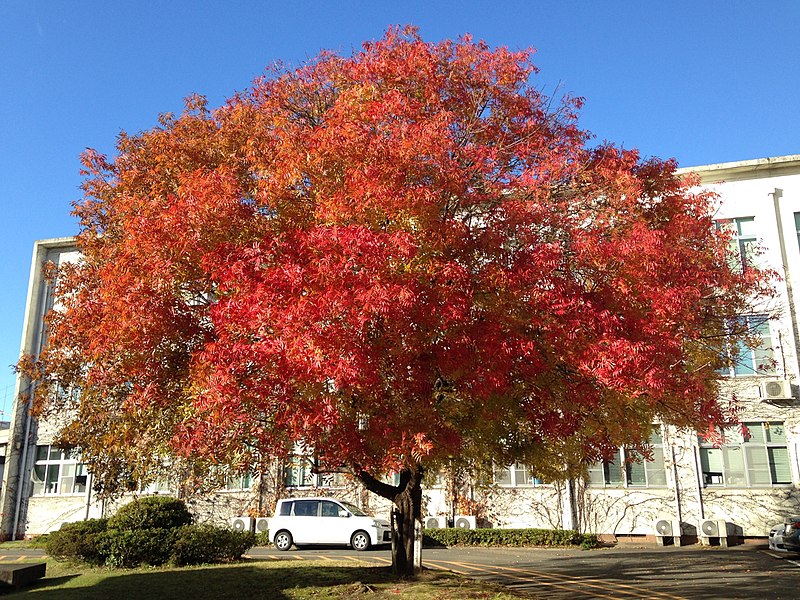
In the low-elevation deserts of Arizona, the Chinese Pistach is the only tree whose leaves turn a vibrant scarlet in the fall, making it a stunning addition to any landscape. Its foliage is dark green in the summer and turns orange or orange-red in the fall, creating a beautiful display of autumn colors.
The Chinese Pistach is native to central and western China, Taiwan, and the Philippines. It is a small to medium-sized tree, growing from 9-15 meters tall, and exceptionally up to 25 meters. The leaves are deciduous and pinnate, with 10 or 12 leaflets, and the terminal leaflet usually absent. The tree produces small red drupes containing a single seed.
This tree is most highly regarded in warm climates and grows best in full sun. It is also the most frost-tolerant species of Pistacia, withstanding temperatures down to about -25°C. Chinese Pistach is also disease-free, making it a low-maintenance choice for street trees or shade trees.
Not only is the Chinese Pistach a visually appealing tree, but it also has practical uses. In China, the oil from the seeds is used for biodiesel production. In Florida, it is used as a shade tree and as understock for the edible pistachio nut tree, P. vera.
If you're looking for a tree that can thrive in urban environments and provide beautiful fall colors, the Chinese Pistach is an excellent choice. Visit our website for more information on this impressive and versatile tree.
Best grown in zones 6-9.
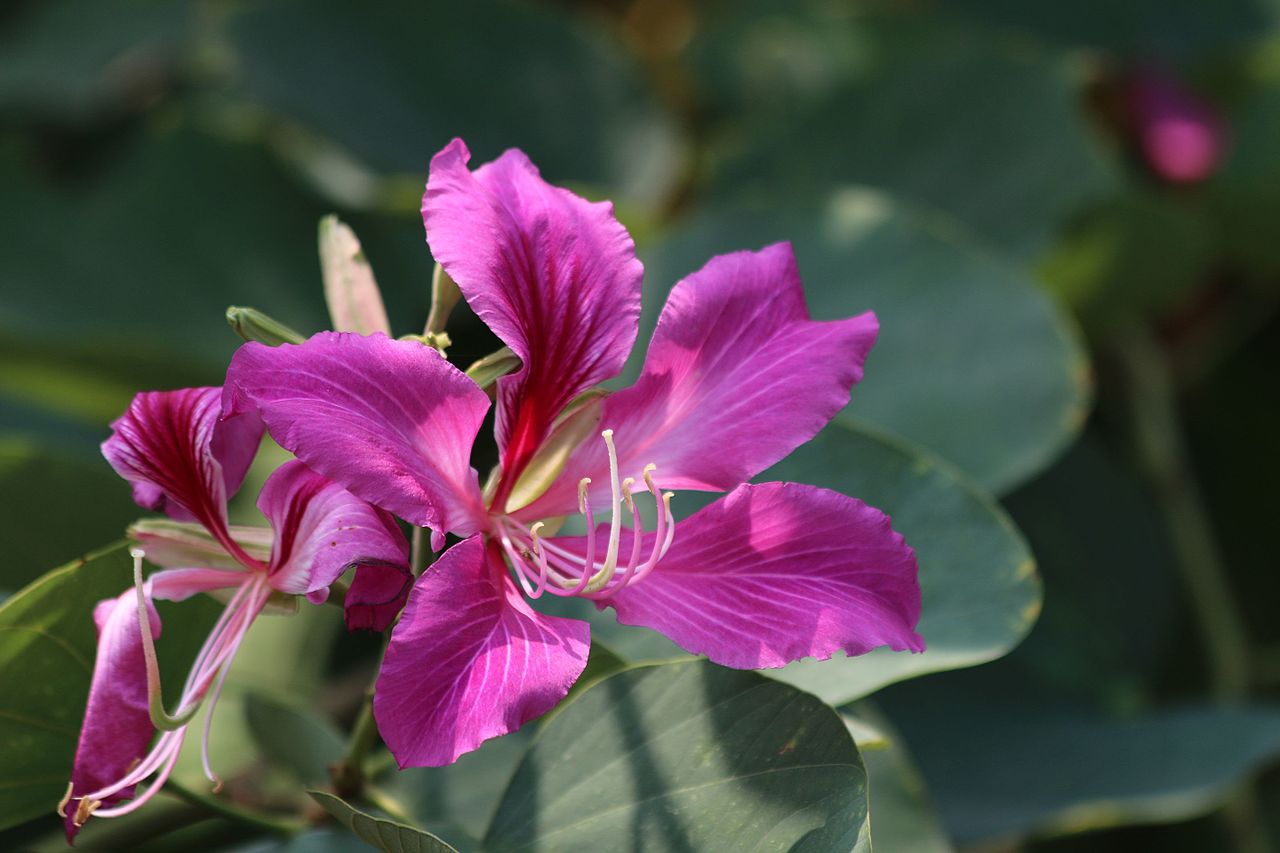
It is a small to medium-sized deciduous tree growing to 17 m tall. The leaves are 10-20 cm long and broad, rounded, and bilobed at the base and apex. The flowers are conspicuous, pink and fragrant, with five petals. For zones 9-10.
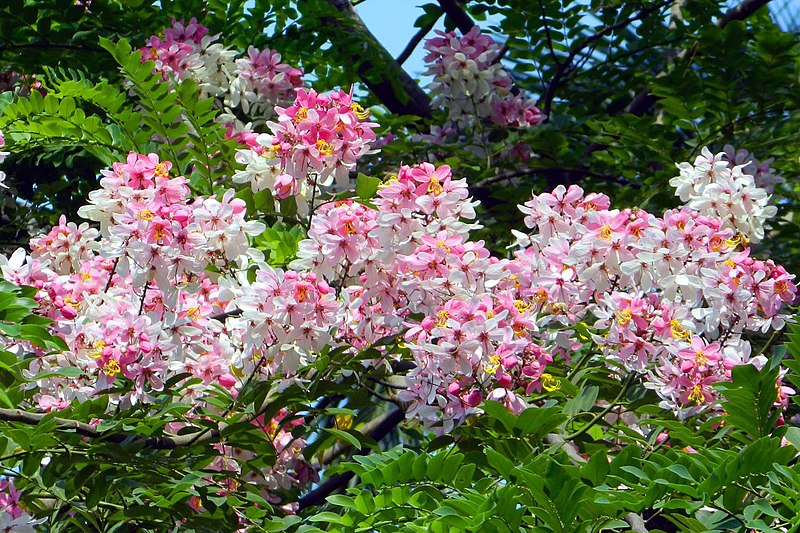
Lovely, tropical, rich green, pinnate foliage. Briefly deciduous during dry season. The flowers range in colour from pale pink to crimson with yellow coloured stamens and are found in open clusters. The ground under the tree is covered with a beautiful carpet of pink towards the end of the flowering season.
For zones 9A through 11.
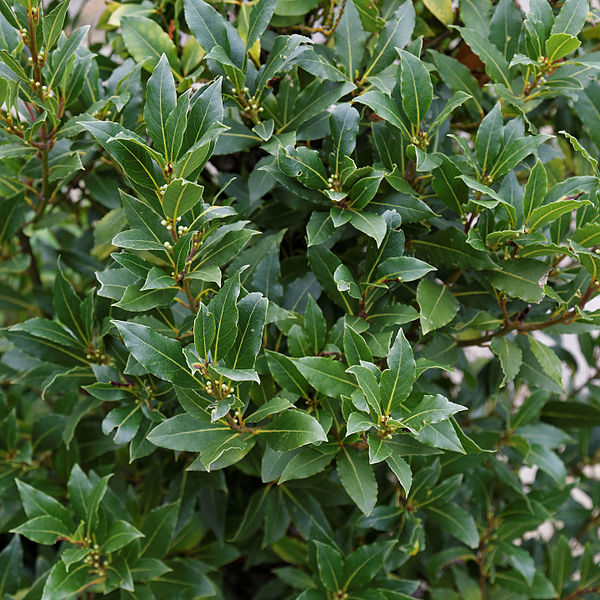
Location: Bay laurel is native to the southern Mediterranean
region. It is grown commercially for its aromatic leaves in
Turkey, Algeria, Morocco, Portugal, Spain, Italy, France, and
Mexico.
Culture: Light: Bay laurel grows best in partial shade.
Moisture: Water when dry. Bay laurel thrives with frequent
watering in rich, well-drained soil.
Hardiness: USDA Zones 8 - 10.
Usage: Where hardy, grow bay laurel in a woodland garden or as
a specimen. Protect from cold winter winds. Bay laurel is an
excellent shrub for hedges and a favorite for topiary sculpture
because it responds very well to pruning. It can be trained as
a standard or allowed to grow as a spreading shrub. In cooler
regions, grow in a container and bring indoors in winter.
The popular culinary seasoning, bay leaf, is used extensively in French, Italian, Spanish and Creole cooking. It flavors soups, stews, shellfish boils, pickling brines, sauces, marinades, and poultry and fish dishes. Always remove the bay leaves before serving, because they are sharp and can cut the mouth and throat. French chefs place bay leaves, parsley and thyme in a little bundle called a bouquet garni that is removed after cooking. Pick bay leaves early in the day and dry quickly under weight so they won't curl. Store in an air-tight jar.
Features: Bay laurel is the true laurel of Greek and Roman
mythology. A poet laureate is an accomplished poet, and the
Roman poet, Ovid, retold the story of the Greek nymph, Daphne,
who was transformed into a laurel tree by her father, Peneus,
so that she could avoid the amorous pursuit of the god, Apollo.
(Cupid had shot an arrow into the fair maiden's heart so that
she would not love Apollo.) Thereafter, Apollo wore a wreath of
laurel to show his love for Daphne. Laurel has always
symbolized victory and merit, and a baccalaureate (baca lauri,
Latin for "laurel berry") still is a symbol of accomplishment.
Bay laurel has been credited with magical properties, like
protecting from witches, the devil and lightning.
The leaves and berries of bay laurel contain the essential oils
eugenol, cineol and geraniol, which account for the distinctive
spicy aroma. Infusions are reputed to soothe the stomach and
relieve flatulence. An oil pressed from the berries was once a
popular liniment for arthritis and sore muscles, and still is
used in perfumes, candles and soaps.

 By Photo by David J. Stang [CC BY-SA 4.0 ], via Wikimedia Commons
 As its vernacular name Norfolk Island pine implies, the tree is endemic to Norfolk Island, a small island in the Pacific Ocean between New Zealand and New Caledonia, about 900 miles east of Sydney, Australia. The genus Araucaria occurs across the South Pacific, especially concentrated in New Caledonia (about 400 miles due north of Norfolk Island) where 13 closely related and similar-appearing species are found. It is sometimes called a star pine, Polynesian pine, triangle tree or living Christmas tree, due to its symmetrical shape as a sapling, although it is not a true pine.
Young trees are often grown as houseplants in areas where the winters are too cold for them to grow outside (they will not, for example, survive outdoors in most of North America or Europe), and are sometimes used as Christmas trees. It will not survive in areas subject to prolonged cold. Large numbers of Norfolk Island pines are produced in south Florida for the houseplant industry. The bulk of these are shipped to grocery stores, discount retailers and garden centres during November.
For indoor use, this tree may be grown in containers or tubs in fertile, porous, sandy, peaty, slightly acidic, well-drained soils in fairly cool conditions (55-65 degrees F). Full sun is normally best for developing compact symmetrical growth, but some light afternoon shade may be needed to avoid possible foliage bleach (yellow tints). As a houseplant, it will generally adapt to the warm, dry atmosphere found in most offices and homes. Consider weekly or biweekly applications of dilute liquid fertilizer from spring through fall. Avoid soils that are too wet or too dry.
Winter hardy to USDA Zones 10-11. When grown outdoors, this tree prefers deep, porous, moderately fertile, reasonably moist soils in full sun. Tolerant of some dry soil conditions however. Also tolerant of windy conditions. May be grown from seed sown in moist, sandy, peaty soils, but seed-grown trees typically have widely-spaced tiers of leaves that are less ornamentally attractive than the leaves found on trees raised from terminal cuttings. Best growth generally occurs in sub-tropical regions.
Note: Seeds are cold stratified and must be planted as soon as they are received.
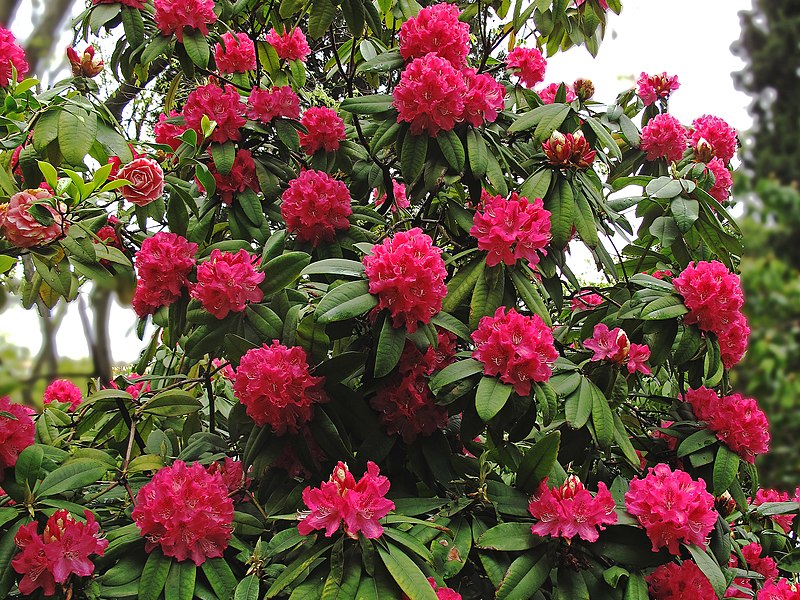
One of the most stately and impressive species rhododendrons, Tree Rhododendron is the state tree of Uttarakhand. It is extremely variable in stature, hardiness, flower color and leaf characteristics. Its species name arboreum means tree-like. It has broad, dark green leaves, 3-7 inches long, with a silvery, fawn or brown hairy coating beneath. In early and mid spring, trusses of 15-20 bell-shaped flowers, 2 inches wide and 1.25-2 inches long are produced in mostly scarlet color, but can be various shades. They have black nectar pouches and black spots inside. This plant holds the Guinness Record for World's Largest Rhododendron. In fact, a scarlet Rhododendron arboreum on Mt. Japfu, Nagaland reached a height of 60 feet. Rhododendron is native to Himalayas, from Kashmir eastwards to Nagaland.
Rhododendron arboreum prefers moist, humus rich, well-drained soils. It prefers an acidic pH of soil. Hardy for zones 6-9.
Plant these seeds on the surface of the soil (do not bury them), water and keep moist until germination. Place the pot in a clear plastic bag to help retain moisture/humidity on the seeds until they germinate, at which time the bag should be removed. Germination occurs in approximately 6 weeks.

Best suited for zones 3-9.
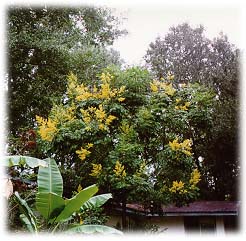
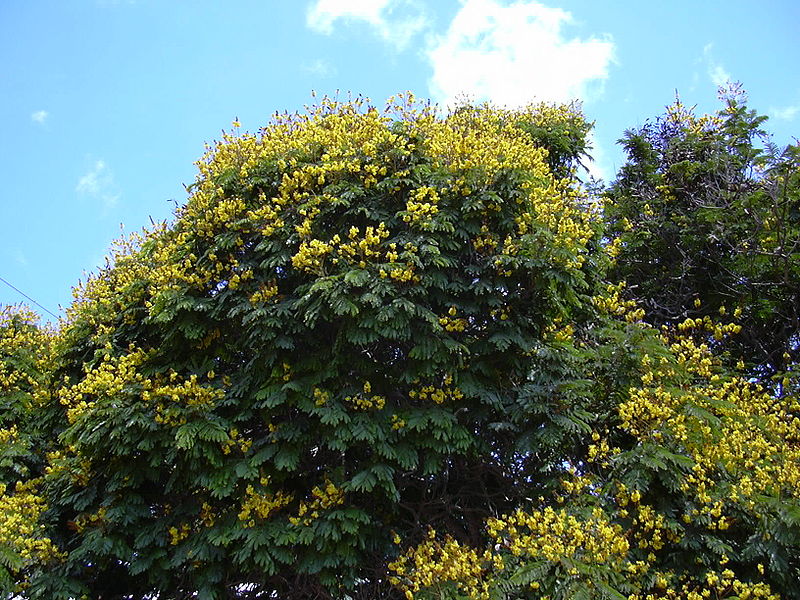
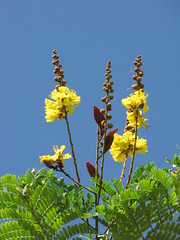
With proper training and pruning in the nursery and in the landscape, a more uniform crown will develop. The dark green, delicate, feathery leaflets provide a softening effect for the tree's large size and create a welcoming, dappled shade. From May through September, the entire tree's canopy is smothered with a yellow blanket of flowers, appearing in showy, terminal panicles and exuding a delicious, grape-like perfume. These flower clusters are followed by four-inch-long seed pods which ripen to a brilliant, coppery red.
Medicinal uses: bark for dysentry, tooth powder, eye lotion, embrocation for pains and sores; the bark gives a dye of a yellow color. Can be used as a shade or specimen tree.
USDA hardiness zone 10b. It is a fast-growing tree. Temperatures in the high 20's cause the leaves to drop but these are quickly replaced. Young trees flower in 2-3 years from seed.
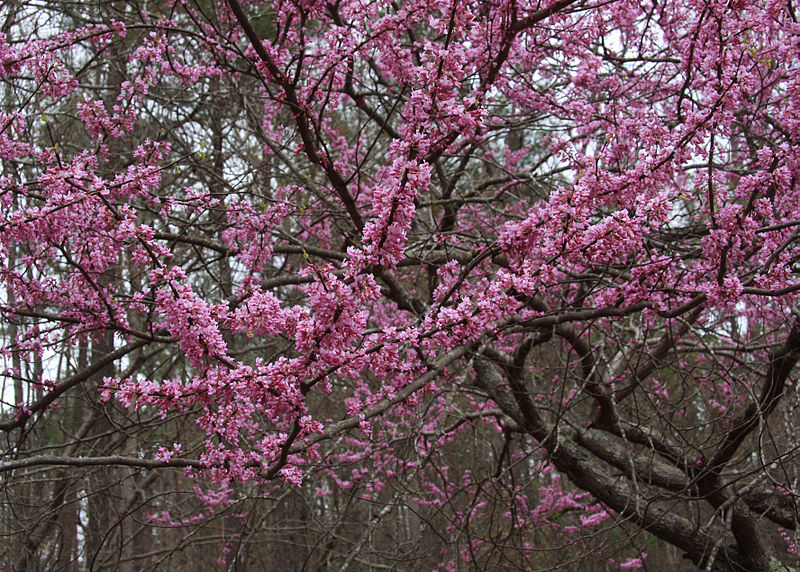
Seed of the redbud have hard, impermeable seed coats in addition to dormant embryos. Seed require both scarification and cold stratification before they will germinate. Redbud seed can be scarified by submerging seed in boiling water for one minute. Once scarified, the seed should be cold stratified at 35 to 41 °F ( simply place seeds in fridge ) for 5 to 8 weeks. Seed should be planted promptly at a depth of 1/4 inch.
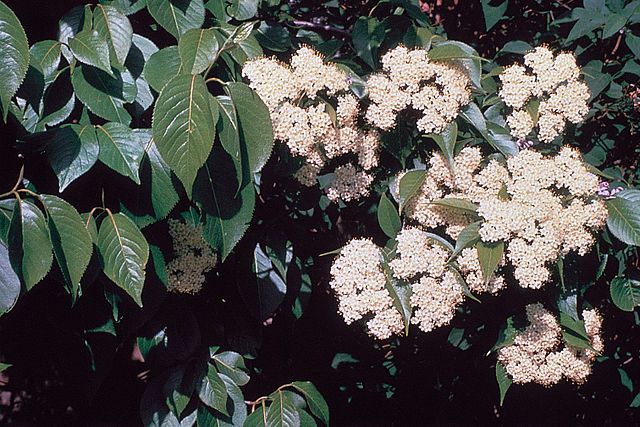
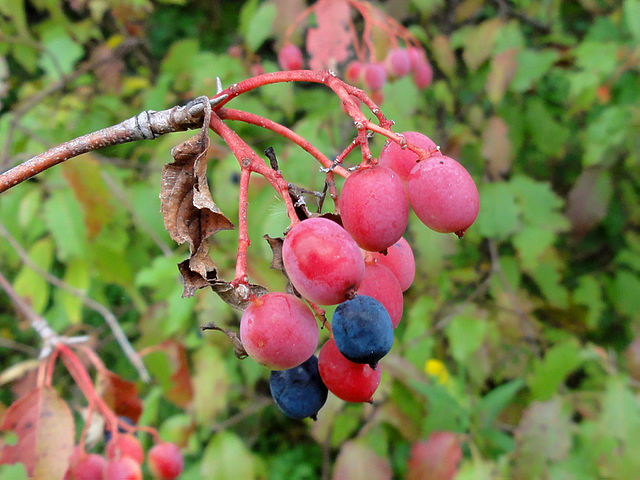
Viburnums offer excellent support for birds and pollinators, and serve as host plants to numerous butterflies and moths. They tend to flower profusely whether or not pollination occurs. However, poor fruiting will happen if there is only one Viburnum available, so try to grow at least two somewhat close together. The edible berries can be used to make jams and jellies.
It can grow 15 to 20 feet tall and should be spaced about 15 feet apart. Hardy for zones 2-8.
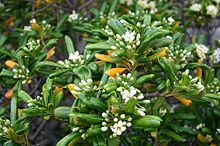
Does well in the shade or full sun, making it a useful lawn shrub.
The leathery leaves are glossy on the top with undersides that are lighter and have a dull surface. These very ornamental leaves reach a length of from 1 to 5 inches and up to 1 inch wide.
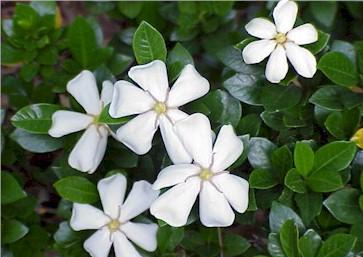
However, our favorite feature is the waxy white flowers that add a delightful fragrance to the spring garden. Japanese mockorange is named so because the scent put forth by its blossoms is similar to that of the sweet orange (Citrus sinensis). The small flowers are about a half inch in diameter and are held in clusters at the branch tips. They are pure white when they emerge from the bud and slowly age to a mellow creamy yellow. They appear in late spring and last for several weeks.
Native to China and Japan, it is used as an ornamental in milder climates throughout the world. In the USA, it is a popular landscape item in Florida, along the Gulf Coast and throughout the Pacific Northwest as well as a patio plant in cooler climates.
Hardy for Zones 8-10. A good choice for screens and informal hedges. It can also be closely sheared to create formal hedges and will also grow well in containers. The beautiful evergreen foliage and ability to produce its fragrant flowers indoors make this a desirable greenhouse plant.
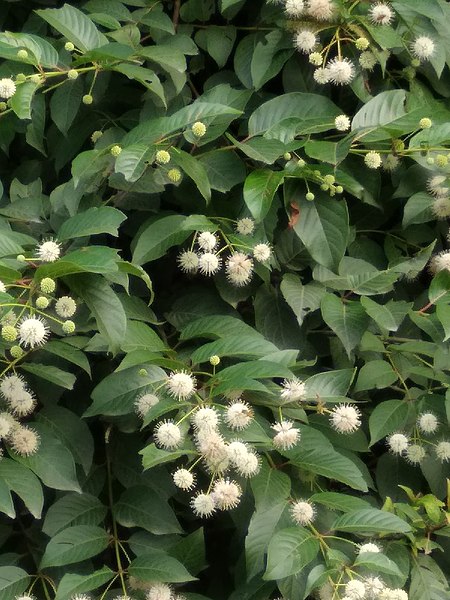
The fragrant flower heads mature into round fruits each containing hundreds of nutlike seeds that are eaten by waterfowl and other birds such as quail. Many birds use this deciduous shrub as a nesting site. It is a tremendous source of nectar for hummingbirds, butterflies and other pollinators and should be grown close to gardens when possible to help with pollination.
Buttonbush is naturally found in wet areas that are usually too wet for other perennial species to establish and thrive, but will grow just about anywhere you plant it, including upland sites, but not in really dry soil.
If you have a spot that has standing water during parts of the year, this is the plant to make that spot beautiful!
It makes wonderful cover to protect ducks from predators, crappie absolutely love to spawn under them, bees utilize the flowers to make excellent honey, deer love the new growth, and the list goes on.
Thanks to its super fast growing root system, buttonbush is great to use as an erosion control and water quality tool, such as in stream bank stabilization and mitigation projects.
Aside from the many wildlife and environmental benefits, buttonbush provides a long lasting, unique bloom display, and the glossy leaves show streaks and splotches of blood red color before dropping in the fall.
Zones 6-10.

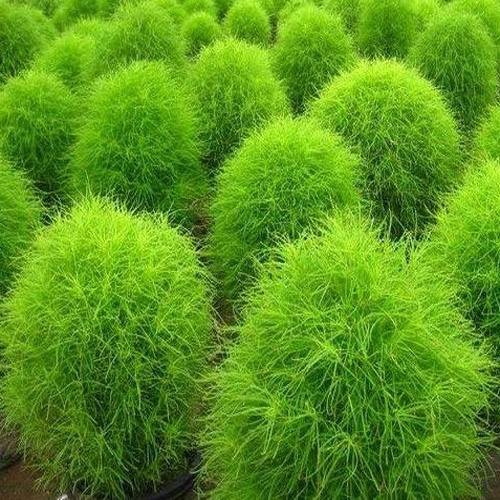
It reaches 28 inches in height and looks great when grown as a hedge along the border or in groups of 3 for focal interest. For areas with a long growing season, Kochia Burning Bush seeds can be started directly outdoors in a prepared seed bed. For earlier Kochia plants, start the seeds indoors. Transplant outdoors after danger of frost has passed. Plant in full sun. Annual.
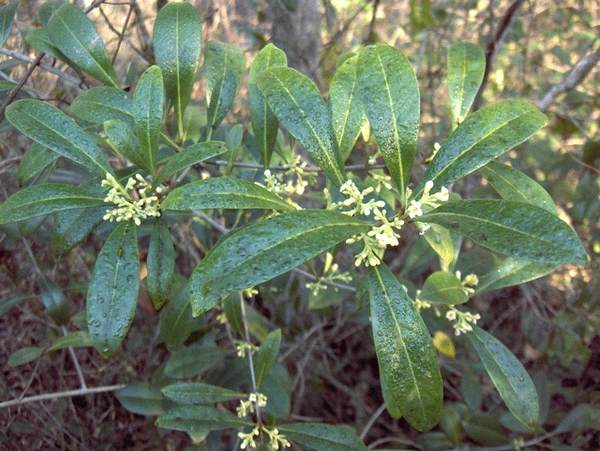
It is a small, evergreen shrub or tree with a narrow, oblong crown, 15 to 20 feet tall, and sometimes reaching 50 feet. The leaves, which last year round, are opposite with a smooth to slightly wavy margin and rusty colored underside. The bark is gray-brown and finely scaly. In spring, small, urn-shaped, fragrant white flowers mature on the previous year's growth. The small tree produces a dark blue drupe that matures in the fall.
Tolerates a range of soil conditions as well as wind. It prefers partial shade and moist, well drained soil. It takes well to pruning and can be shaped as desired.
For zones 5b to 9b.
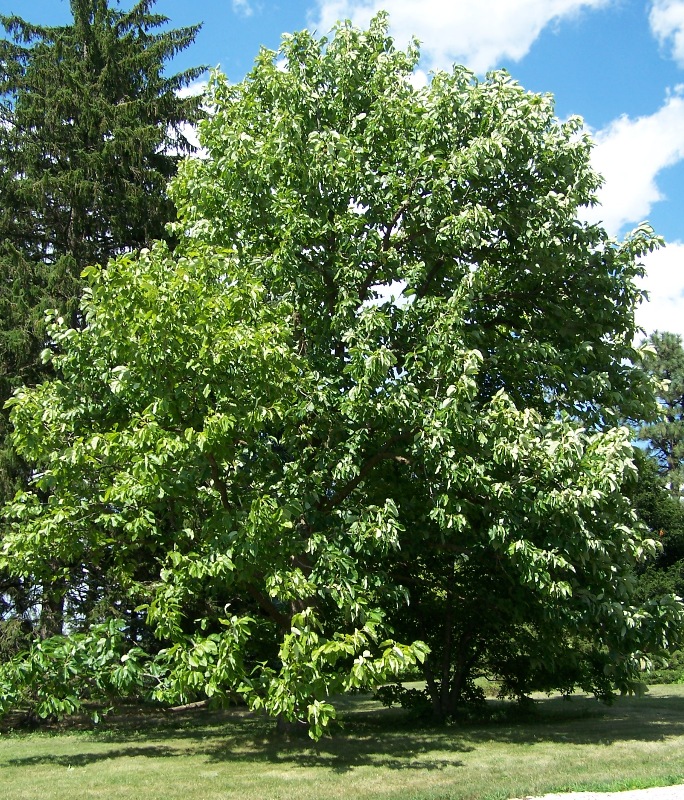
Unlike most magnolias, the flowers are not showy. They are typically small, yellow-green, and borne high in the tree in April through June. The leaves of Magnolia acuminata are pointed at the tip and provide it with its name - 'acuminate' means tapering to a fine point. The name Cucumber Tree refers to the unripe fruit, which is green and often shaped like a small cucumber.
One of the few magnolias that will serve as a shade or lawn tree. Needs a large space. Flowers are fragrant and foliage releases a slightly spicy fragrance when crushed.
Hardy for zones 3-8.
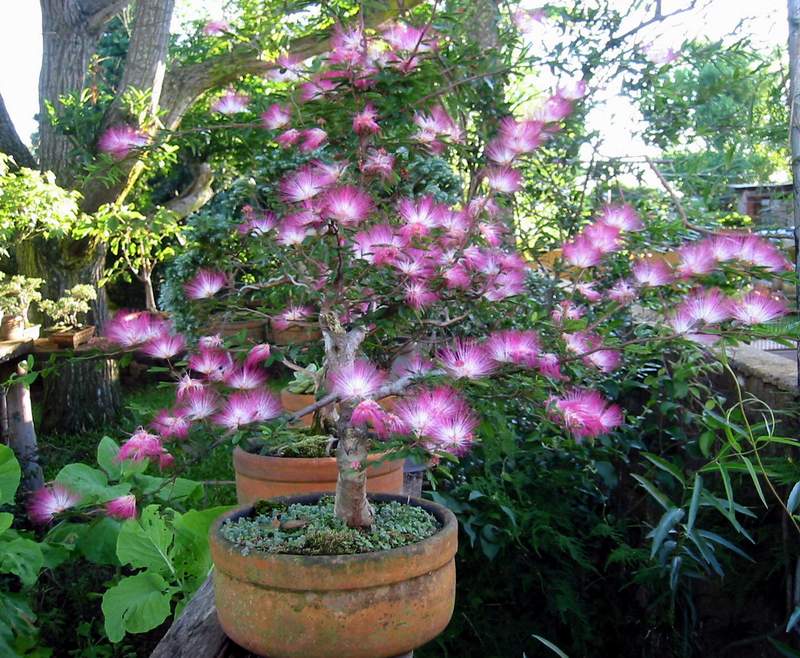
Outside, it can be formed into a handsome small shrub-like tree that grows to 4 feet tall. It is well known for its fuzzy pink-red flowers and delicate feathery leaves. A fine houseplant in cooler zones if given bright light, it also makes an excellent bonsai. For warm zones. Flowering in Spring and fall. May also be grown indoors in sunny location.
Hardy to five degrees outside, it may die back to ground, but will come back in spring.
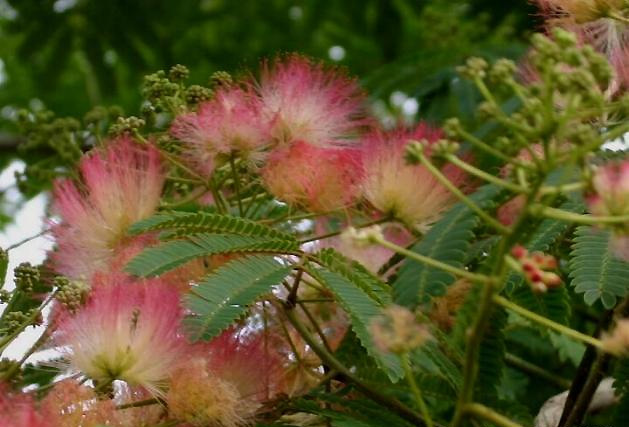
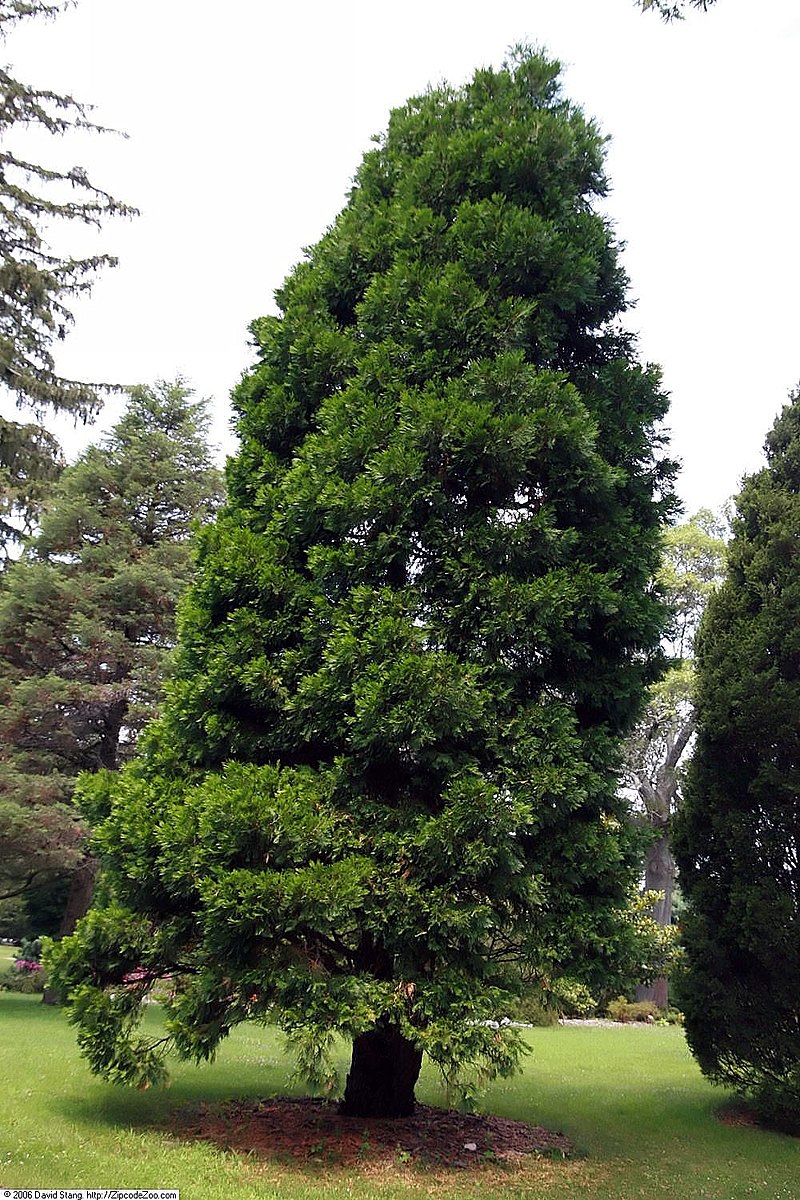
A small pyramidal shaped cedar that is prized for its very fragrant leaves and wood. Easy to start from seeds. A very beautiful bonsai specimen. Incense cedar is an evergreen tree with a skinny, columnar shape in youth, becoming only a little more rounded at maturity. In its native habitat it can get as large as 150 ft (45.7 m) tall with a trunk diameter of 6 ft (1.8 m). In these very large trees, the long straight trunk is swollen and buttressed at the base and usually free of branches for half its length.
Incense cedar does best on well-drained, slightly acidic sandy loams in cool, mountainous areas. Outside its natural range it tends to stay smaller and bushier. Even under ideal conditions, incense cedar is a slow growing tree. But, it can live 1000 years or more. Grows in full sun or part shade. Incense cedar needs lots of moisture to realize its full potential as a large tree. If it gets less water than ideal it will survive, but remain as a smaller, bushy, but still attractive specimen. Hardiness: USDA Zones 6 - 8. Incense cedar does quite well in zones 7 and 8, but usually doesn't get as large as it does up north. Propagation: Incense cedar is difficult, but not impossible, to propagate from cuttings.
The generic name means "beautiful cedar", and that it is. The tall, columnar incense cedar is a handsome specimen for framing a formal landscape. A line of them, like soldiers at attention, adds a formal dimension to driveways and makes a great windbreak or tall screen.
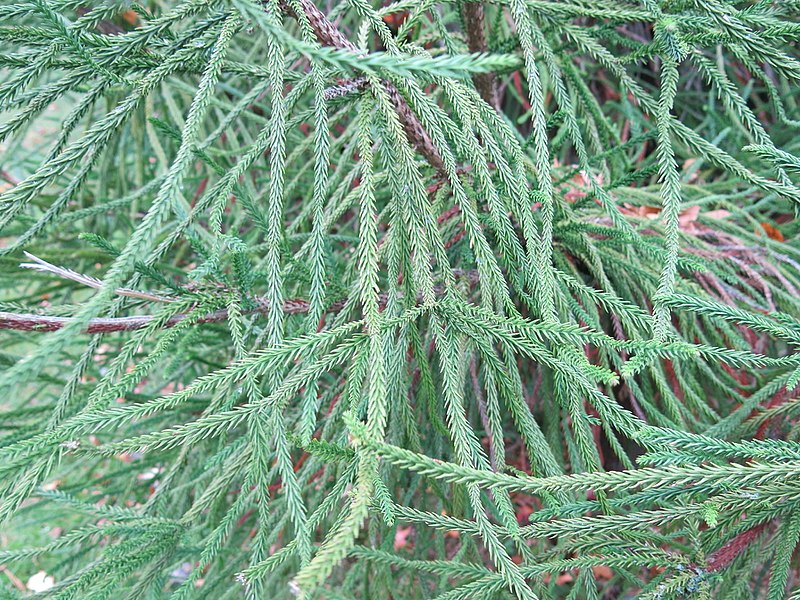
It is native to southern Japan as well as southern China where it is found in a variety of forests from near sea level to over 8200 feet. In cultivation, it is popular as a forestry and ornamental tree in Japan and China as well as elsewhere around the world. It is very easy to grow and will do well in USDA Zones 7 and above.
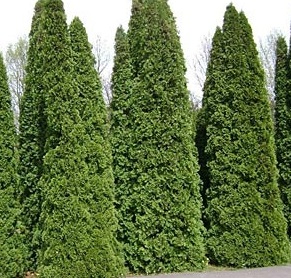
A medium to fairly large, very long-lived conifer widely distributed in temperate forests in northeastern North America with much-branched shoots that are covered in tiny, scalelike, fragrant evergreen leaves.
The relatively slender trunk rarely reaches more than 3 feet in diameter and has flaking, reddish-brown bark. Its is one of the most popular conifers in the temperate garden in USDA Zones 2 to 8 and much used for hedges and screens.
It has many medicinal applications and the wood is very rot resistant.


Best suited for zones 8-9.
Culture: Light: Partial or broken shade is best, but
flowering dogwood can tolerate full sun, too. It does best with
some shade in the south and full sun in the north. Moisture:
Established specimens are tolerant of normal dry periods, but
will need supplemental watering during extreme droughts. Stress
of any kind makes dogwoods susceptible to diseases. Hardiness: USDA Zones 5-9. Usage: Flowering dogwood is one of the most popular
ornamental specimen trees in eastern North America. Use dogwood
as a framing tree or as a background tree. They are excellent
beneath large oaks or pines. Dogwoods are among the earliest
springtime bloomers, brightening the landscape along with
azaleas, spireas, forsythias and redbuds. With its dense crown,
flowering dogwood provides good shade, and due to its small
stature, it is useful in the smallest yards. Features: The graceful yet compact shape and brilliant
springtime blooms make this a favorite landscape tree
throughout its range. The flowering dogwood is just about the
finest flowering tree you can find. It is beautiful in all
seasons and even though it is nearly ubiquitous in home
landscapes, it never seems to be overplanted.
The unsurpassed beauty of the Tree wisteria as well as the non invasive root system makes this one of the most successful garden trees. Bolusanthus speciosus is perfect for enhancing any area where space is at a premium and is the perfect choice for townhouse gardens. This magnificent tree looks stunning in a mixed border to add colour and height or as a single specimen on a lawn or alongside a patio. John Muir called the giant sequoia "the noblest of a noble
race." The giant sequoia is a columnar or cone-shaped tree,
losing its lower branches and becoming flat-topped with age.
Trees more than 100 years old typically are free of branches to
a height of 100' or more. In cultivation, giant sequoias
usually grow no more than 60-100' tall and retain their lower
branches which may droop down to touch the ground and sometimes
take root. The reddish brown bark is very thick (up to 20"
thick) and deeply fissured. Location: Giant sequoia grows naturally in isolated stands
on the western slope of the Sierra Nevada range in central
California, from 4,000' to 8,500' above sea level. The
northernmost grove, consisting of six trees, is in Placer
County, and the southernmost grove of 100 trees is in Tulare
County, 260 miles to the south. The largest concentrations and
best stands are in Kings Canyon and Sequoia National Parks,
where there are whole groves of giant sequoias with trunk
diameters exceeding 20' and heights exceeding 275'. These are
truly majestic cathedrals that only God could make! Culture: Giant sequoias are cultivated in Europe and eastern
North America as well as the US West Coast. They do best in a
moderately fertile, deep, well drained soil, in full sun to
partial shade. They like a cool climate. Giant sequoias grow
rapidly for the first few centuries, then slow down as they
surpass 150' in height. Location: Cedar of Lebanon is named for the famous forests that grow in Lebanon. The species also occurs in Turkey and Syria. Var. stenocoma is native to southern Turkey.
Clusters (corymbs) of small white flowers appear in spring.
These are up to 2 in (5 cm) across and are borne close together
creating the appearance of nearly solid surface of flowers. In
fall the 1/4 in (0.6 cm) berries begin to ripen, their color
mellowing from green to shades of red, orange, or yellow. These
persist through winter and into early spring depending on
climate and appetite of the local bird population. Under bright
sunny conditions the berries are plentiful but expect smaller
crops in shadier situations. The color of both leaves and
berries tends to be darker in cooler climates. Culture: Not particular about soil and requires little or no
supplemental fertilization. Landscapers love the firethorns for their fast rate of
growth and ability to withstand drought and neglect. The shrubs
ruggedness and disease and pest resistance makes this plant a
very popular item in commercial landscapes. Contact Us | Privacy Policy | About Us
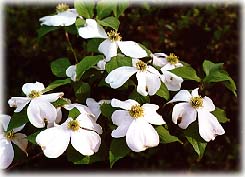
However the showy parts of the bloom are the large oval-rounded showy white involucre bracts (one 3-4 inches long and the other 6-7 inches long) which subtend each flower cluster. The bracts flutter in the slightest breeze, and, from a distance, purportedly look like white doves sitting in the tree, hence the common name.
Flowers are followed by round, greenish-brown, golf ball-sized fruits on 2-3” stems. Toothed, broad oval, red-stalked, bright green leaves (3-6” long) are heart-shaped at the base. Variable fall color ranges from undistinguished dull pastels to bright oranges and reds.
It will take a few years to bloom when started from seed, and it has to be warm, then cold statified before germinating, but it is well worth the effort and wait.
Warm stratify for 120 days followed by 90 days cold. Sow the seed no more than 1/4" deep in a well aerated soil containing sand and perlite as well as vermiculite in equal parts. Germination may take up to 18 months after the pre-treatment requirements have been met. Each seed may have up to 10 individual seed chambers so a sinlge seed can produce multiple seedlings. When the first sprout is seen, remove the seed from the seed bed and separate the sproutling from the seed (once enough roots exist to support the sprout) and then re-plant the seed in the seed bed to await the next sproutling. If left attached to the seed the sproutling may inhibit the germination of the other seed chambers as well as creating strong competition between the sproutlings from an individual seed.
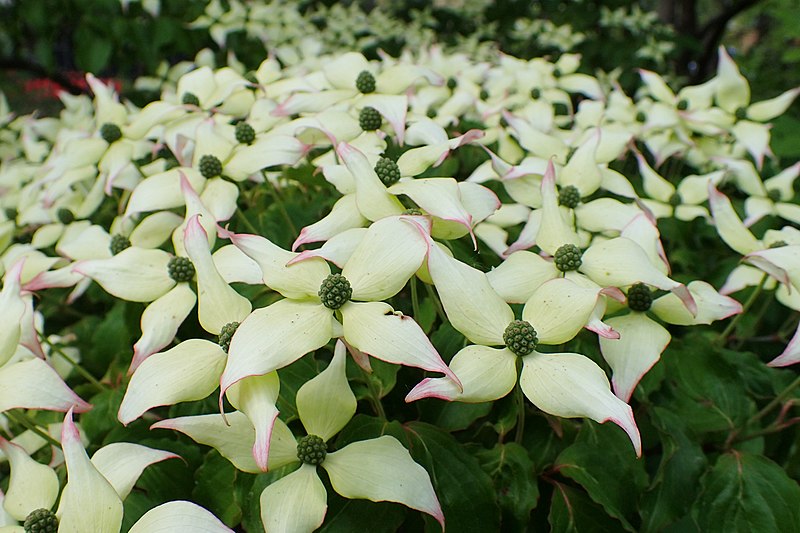
Kousa dogwood is an excellent small specimen tree for small lawns. Two outstanding characteristics are the four-petaled, white flowers that appear above the foliage in June and reddish-purple fall color. In the Midwest, this is a hardier substitute for the acid-loving flowering dogwood. The shallow root system will benefit with a layer of mulch to maintain a cool root environment.
Kousa Dogwoods are very showy for a long period of time as the flower bracts are showy longer than most flowers. They'll give you up to a month of display. The flowers precede the red fruit, which looks like a raspberry. Some people make jellies, jams and wine from the round red berries, or, leave the red colored fruit for birds! They'll be happy to snap them up for you without any fuss or muss.
best suited for zones 5-8.
The wood of dogwood is very hard and has some value in the
forest products trade for such things as commercial loom
shuttles and spindles. In colonial (U.S.A.) times, a tea brewed
from the bark was said to reduce fevers. Squirrels and birds
devour the pretty red fruits.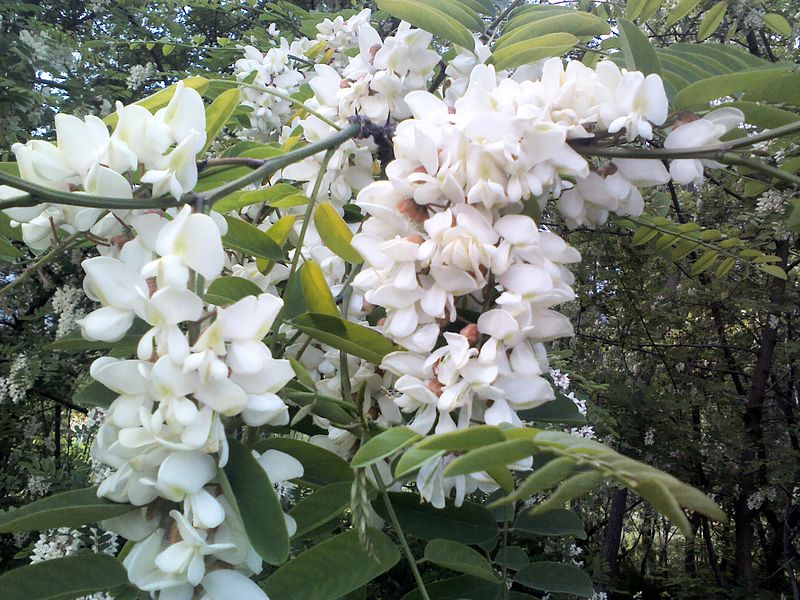
An excellent shade tree with acacia type foliage that will mature at about 50 feet tall and 25 feet wide. Normally has thorny stickers. The fragrant flowers can be smelled for hundreds of feet in spring. This is a tree that grows well in poor soil and can be an aggressive grower in good soil, so probably best suited for areas you want to dress up or hide, and do not mind the suckering growth.
The bruised foliage mixed with sugar will attract and kill flies, a useful attribute.
Cannot ship to New York state. Grows well in zones 3-9.
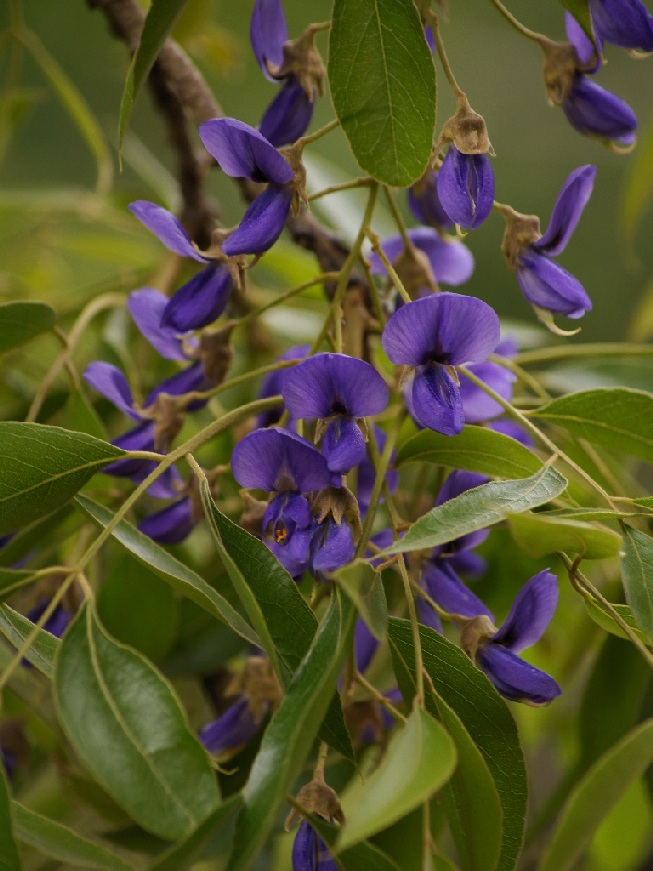
Although it is deciduous, the Tree wisteria is only without leaves for a short time in early spring. The conspicuous dark, brownish black trunk, offsets the light green leaves and the magnificent flowers to perfection.
It is a protected species in South Africa which means that no wild specimens may be damaged, cut down or removed.
When planted in a group of 3 or 5 the effect is superb while an avenue of these lovely trees along a driveway or street is always a showstopper. When planted in large pots the Tree wisteria creates a stunning focal point for patios and paved areas. This tree is very popular with Bonsai enthusiasts.
The beautiful, hard wood of Bolusanthus speciosus is used to make excellent quality furniture and household articles. Being termite resistant, the straight stems are used for fence posts. Both the roots and parts of the bark are used medicinally to treat ailments such as various stomach problems and abdominal cramps.
Winter Hardiness: 25-30°F

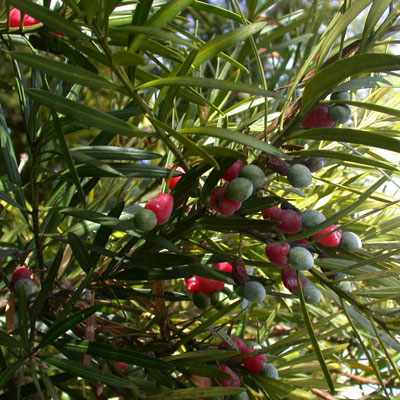
This tough plant thrives in the most adverse conditions, tolerating a wide range of light exposures and soils.
A moderately slow-growing, large evergreen shrub with a strongly-columnar growth habit to 8-12' tall x 4-5' wide. Can be pruned into a small tree. This popular and useful variety features dense-growing medium to deep-green foliage that takes very well to shearing, making it an ideal selection for use as a hedge, screen, background, column or topiary.
Perfect for framing an entryway, for large patio containers, or anywhere a tall, narrow-growing specimen is required. Prefers a neutral to slightly-acidic loamy soil, as clay soils will tend to produce a weaker, less aesthetically-pleasing specimen. Thrives in a partial to full sun exposure.
Zones 7b-11.
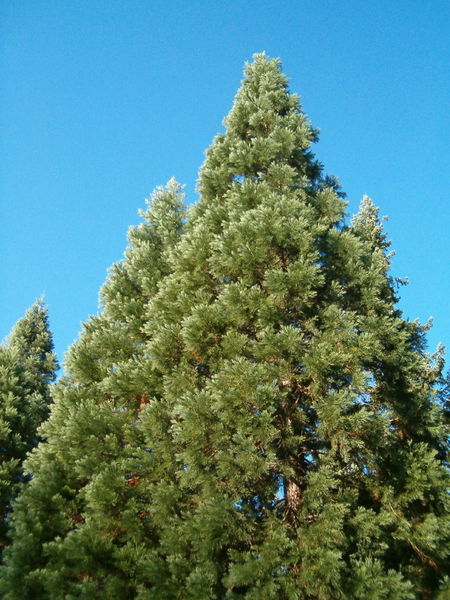
The bright gray-green leaves are scale-like, sharp-pointed,
1/4" long, overlapping each other, and completely covering the
twigs. The egg shaped cones are 3" long, and remain on the tree
for up to 20 years. Unlike the related California redwood
(Sequoia sempervirens), giant sequoia does not sprout from the
roots.
Light: Full sun to dappled shade. Seedlings and young saplings
do best in partial shade.
Moisture: The average precipitation in the natural range of
giant sequoia is 45-60" per year, mostly from snow. Water young
specimens deeply and often.
Hardiness: USDA Zones 5 - 9. Has been reported to survive
temperatures of -22F in Scandinavia. Should be protected from
cold winter winds.
Propagation: Giant sequoia can be grown from seed. Best results
come from seed that has been soaked in water for 24 hours, then
chilled for 30-60 days before planting in mineral soil. Giant
sequoia also can be propagated by rooting soft wood tip
cuttings in summer and semi-hard cuttings in late summer.
Usage: The giant sequoia makes a magnificent specimen tree if
you have the room. In the eastern US, giant sequoia does much
better than California redwood.
Features: Sequoiadendron, like Sequoia, is a monotypic genus in
the baldcypress
The genus is named in honor of Sequoiah (1770-1843), the son of
a British merchant and a Cherokee woman, who became a Cherokee
chief and created an alphabet for his people's language.
Dendron is from the Greek for tree.
By nature, this is a low germinating seed, expect about 15-20 percent germination.

The genus's name, Sequoia, is named in honor of the Native American Cherokee Chief Sequoyah. The epithet, sempervirens, means "evergreen."
It is native to Southwest Oregon to Central California in the moist, foggy, coastal plains along the Pacific Coast.
The Coastal Redwood prefers full sun or light dappled shade. It performs well in rich, moist, and well-drained soil. It is tolerant of wet soil, but it is intolerant to dry soil. This tree will grow best in cool, moist, coastal climates. It does not require pruning. It is propagated by seeds or root cuttings.
The bark is reddish-brown, hard, furrowed, and very thick. The leaves are needle-like, flat, spiral, two-ranked, green on the upper surface, and have two stomal bands on the underside of the needles. The small cones are hard and woody.
Zones 7a-9b.

It is tolerant of wet soils but intolerant of early freezes. This plant has minimal pest and disease problems. It can be utilized as a specimen tree for large areas such as parks, golf courses, large commercial or governmental grounds, and as a "living fossil". It is also tolerant of pollution and can be used as a street tree. It needs plenty of room to grow as it can grow to be 25' wide.
USDA hardiness zones 4–8.
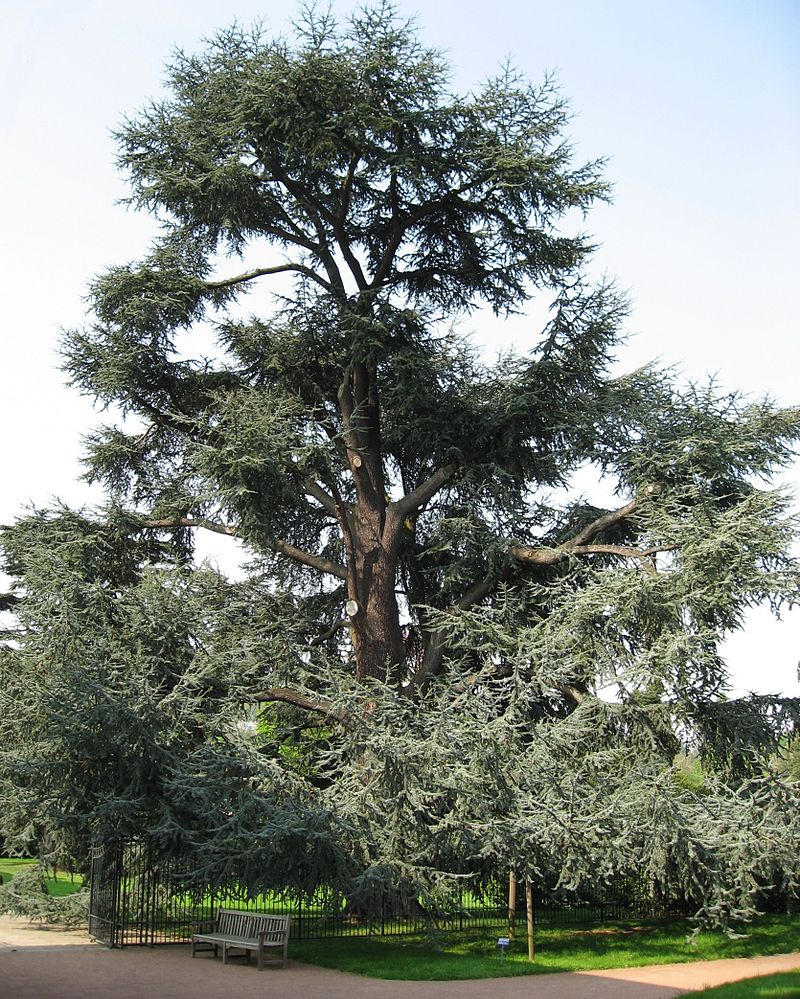
Although it can get more than 100' tall with an equal spread from its strong limbs, most specimens in cultivation can be expected to top out around 50-70'. In youth the tree is conical and symmetrical. The leaves, about an inch long, are stiff and 4-angled, and arranged in dense clusters on short shoots. The cones are barrel shaped, 3-5" long and held erect, a characteristic of the true cedars (genus Cedrus).
Cedar of Lebanon is very similar to (and very closely related to) Atlas cedar (C. atlantica), and some authorities consider them to be just subspecies in the same species. Michael Dirr, the famous authority on landscape trees from the University of Georgia, says Atlas cedar has a taller, less flattened crown, less densely arranged branchlets, and smaller cones (2-3" long) than cedar of Lebanon.
Culture: The cedars grow well in acidic sands and in thin soils over limestone; pH doesn't matter. Good drainage is essential, however. Cedar of Lebanon has a tendency to produce multiple leaders and the grower may wish to prune out the weaker shoots; do this
in autumn. These are slow growing trees.
Light: Young trees can grow in partial shade but will eventually need full sun to realize their potential.
Moisture: Cedar of Lebanon occurs naturally where there is very little summer rainfall, and is quite tolerant of drought. It can thrive where annual precipitation is no more than 15", but it also does well where 80" of annual precipitation is the norm.
Hardiness: USDA Zones 6 - 9.
Usage: The cedars make majestic specimen trees for parks, estates and larger lawns. A mature cedar of Lebanon, especially one with multiple leaders, will be as wide as it is tall, and a truly picturesque specimen.
Features: The taxonomy of the genus Cedrus is debated by the botanists. Depending on who you believe, you can recognize one, two or four species. The splitters recognize Cyprus cedar (Cedrus brevifolia), cedar of Lebanon, deodar cedar (C. deodar), and Atlas cedar.
Germination: 30-50%.
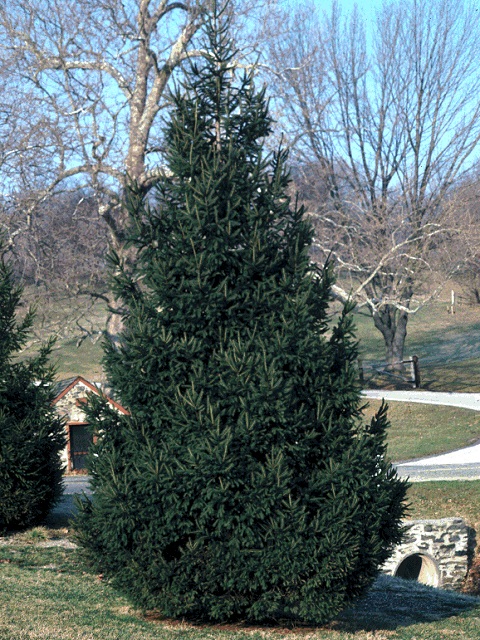
It has branchlets that typically hang downwards, and the largest cones of any spruce, 3 to 7 inches long. The Norway spruce has a wide distribution for it being planted for its wood, and is the species used as the main Christmas tree in several countries around the world.
Norway Spruce Tree can grow to a large height in as little as three years. It will continue to grow rapidly to a mature height of 50 feet. And since it's a dense tree that easily blocks out wind and neighbors, it's ideal for use as a privacy barrier, windscreen, or even a traditional showpiece.
For zones 2-7.
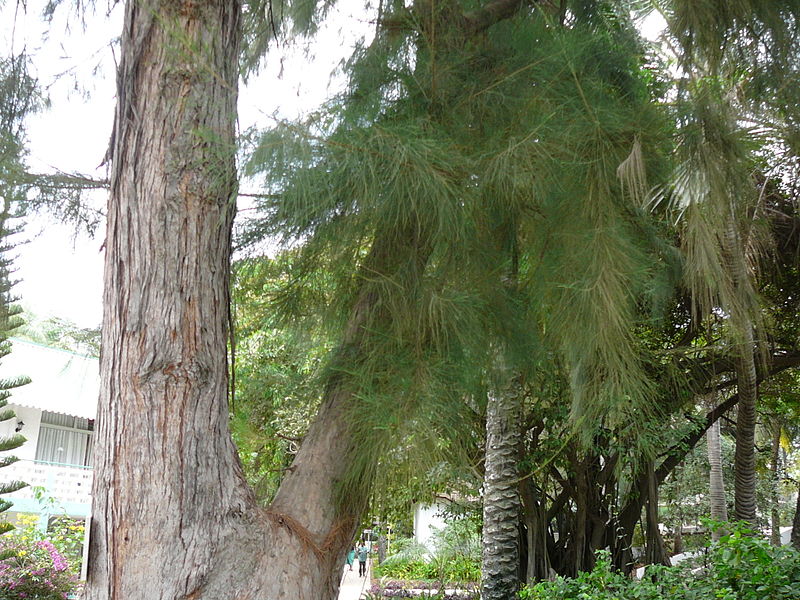
Fruit is a cone to about an inch in length.
Used extensively as a seaside street or park planting this species is wind firm, salt tolerant and nitrogen fixing and consequently it is particularly useful in areas of poor sandy soil where it is a valuable windbreak and soil binder.
They are very hardy trees, drought tolerant but are not frost tolerant to any real degree so are best suited to warmer mediteranean or sub to fully tropical areas, we have seen in survive in zone 9.
This species also makes an excellent bonsai subject. Easy to propagate from seed and it can be grown in pots, tubs or indoors as a houseplant in colder climates.
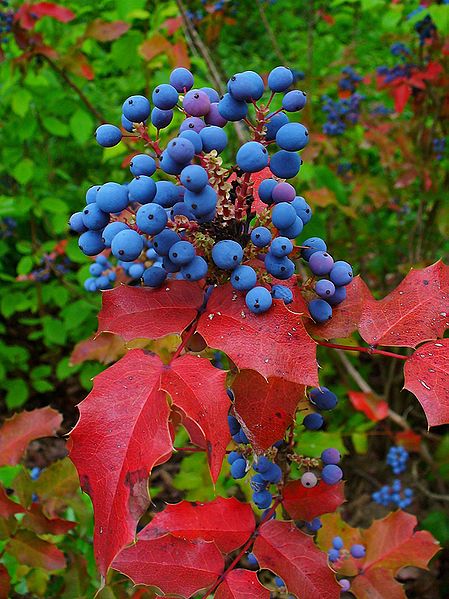
Location: Oregon grape holly is native from the northwestern United States on into Canada. It is widely grown as an ornamental.
Culture: Light: Needs shady conditions, hot direct sun will burn leaves. Moisture: Likes moist soil high in organic material, but adaptable. Hardiness: USDA Zones 5-9.
Propagation: Clumps can be divided.
Usage: This plant thrives in shady areas where selection of plants is limited. Can be used in entry ways and under roof eaves if adequate moisture is maintained. Looks great under a canopy of pine along with azaleas and camellias. Can also be used as an outdoor container plant.
Features: The bright yellow flowers are beautiful against the lustrous blue green leaves. The bright blue berries on dark red stems are even more striking. The grape like berries can be made into jelly.
Oregon Grape Jelly Recipe.
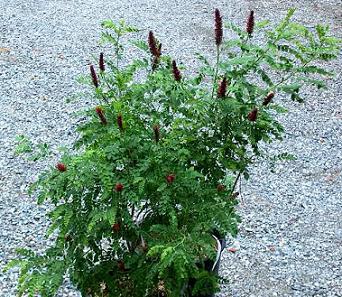
The pink flowers have a delightful honey fragrance. Excellent container plant for use as a fragrant houseplant, and does well outside in almost all soils, drought tolerant.
Perennial. Hardy outside to zone 3.
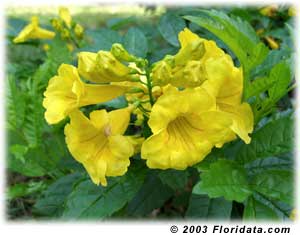
It has bright green opposite leaves, 2-3 inches long with sharply toothed edges. The smooth squarish twigs are green, turning tan or reddish tan as they age. The bark on the main trunk is light brown and becomes corky with age.
The 1-2 inch sunshine yellow flowers are trumpet shaped. They hang in showy clusters at the branch tips and forks, bending the twigs into arches with their weight. There are two folds along the bottom of the flower's throat and several delicate rust-red lines decorating the interior. The blooms appear in flushes throughout the growing season.
They are followed by 4-8 inch long stringbean-like pods that hang in vertical clusters. These turn brown and split open to release flat oblong 1/4 inch seeds with transparent 1/4 inch wings on each end.
Common yellow elder is a Central and South American tree that grows to 25 ft. It has bright yellow flowers and dense, lushly green foliage that is evergreen in tropical climates, but deciduous in chillier places.
Yellow elder will grow on a wide variety of soils, including sand and limerock. The plants can be cut to the ground for rejuvenation in the early spring or carefully sheared during the growing season to control shape and size and promote new flushes of flowers.
This species needs full sun. Yellow elder likes well drained soil. Potted plants should be given minimal water when not in active growth. Hardiness: USDA Zones 7 - 11. Freeze tolerance varies dramatically, with some forms able to survive temperatures down to around 10 degrees and others severely injured by only a few degrees of frost.
Yellow elder is typically deciduous and may freeze back or have a rather awkward shape, so it is best set among more consistent shrubs where it can contribute color to a border or screen. The yellow blooms are spectacular behind blue agave. Since this species drops its abundant blossoms before they wither, it can advantageously be placed where the fallen blossoms will form a pool of gold on the ground. Nurserymen say yellow elder sells best when marketed as a flowering shrub in a 1-3 gal pot and promoted as a tropical patio plant.
Yellow elder has been used for a variety of purposes in herbal medicine. Its primary applications have been in treating diabetes and digestive problems. Extracts from Tecoma stans leaves have been found to inhibit the growth of the yeast infection, Candida albicans. Yellow elder also contains several compounds noted for their catnip-like effects on felines.
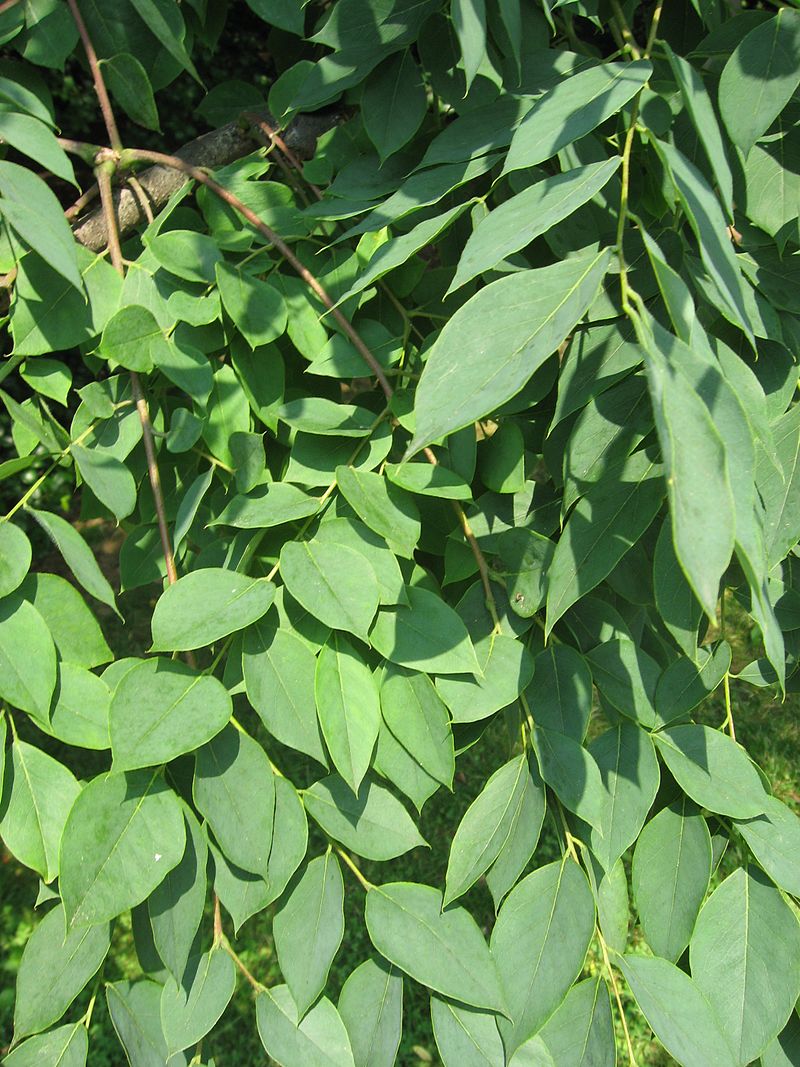
In addition to use as a food, the seeds of Kentucky coffee tree were used by Native Americans for ceremonial and recreational purposes. Seeds were used as dice in games of chance that were common in eastern tribes. The seeds were also used in jewelry.
It has been noted that the bruised foliage when sprinkled with sweetened water will attract and kill flies. Can be raised in containers when young.
Zones: 3 to 8.
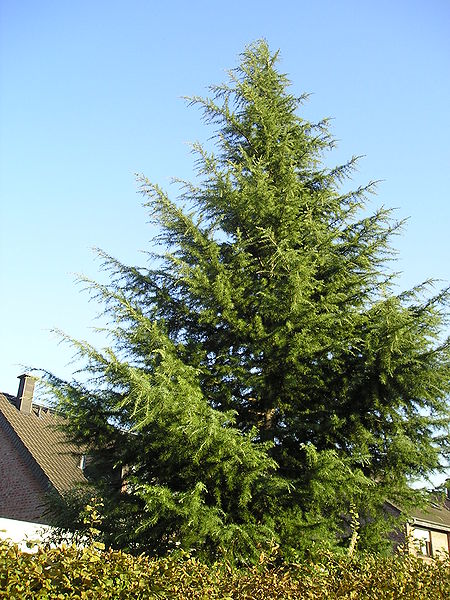
The bluish green female cones are 3-5 in (7.6-12.7 cm) long and
egg shaped. After two years they shatter and release little
seeds with papery wings. The bark is dark brown to nearly
black, smooth on young trees and becoming fissured with
age.
Deodar is native to the Himalayas, where it grows at elevations
of 3,500 to 12,000 ft (1,067-3,658 m) above sea level.
Deodar is fairly fast growing for the first decade or two,
growing as high as 30 ft (9.1 m) in its first 10 years. It is a
long-lived and troublefree tree in most areas. Deodar needs
neutral to alkaline soil.
Light: Full sun. (In whose shade is a 200 ft (61 m) tree going
to grow?)
Moisture: Once established, deodar is drought tolerant.
Hardiness: USDA Zones 7 - 9.
Most cultivars of deodar will grow into large and handsome
specimen trees that need plenty of room. Use these in the back
of a large landscape so they can be seen in their entirety.
From a distance, deodar is dense and plumose, with a fine
texture, and the tip of the tree seems to wave in the breeze.
Some cultivars are smaller and more shrublike. With proper
pruning most deodars can be maintained as bushy shrubs.
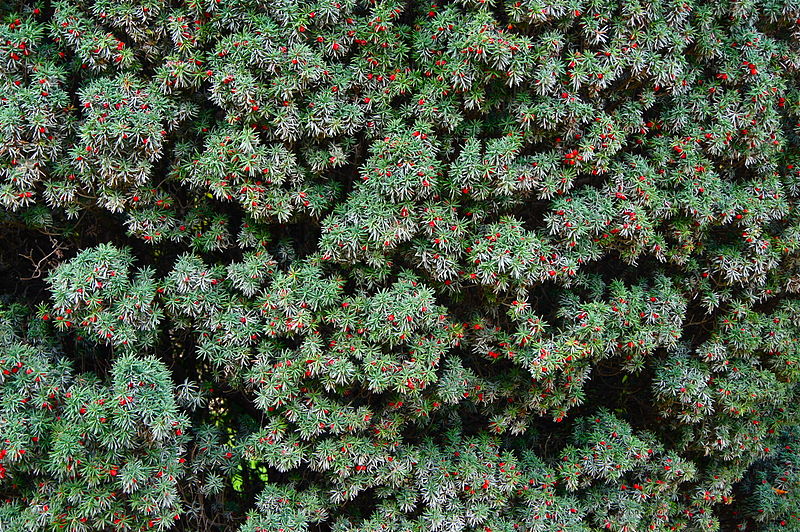
A very useful tree for hedging and topiary. Can be closely trimmed. Must have well drained soil. If let go without trimming, can become a very large bush. One of the few plants which will flourish under Beech and is remarkably tolerant of shade. Yew is poisonous to stock including man but deer have been known to eat it without ill effect. Average annual growth of 20 cm. Zone 6-9.
It is a small to medium-sized evergreen tree, growing 10-20 m
tall, exceptionally up to 28 m. It is relatively slow growing,
but can be very long-lived, with the maximum recorded trunk
diameter of 4 m probably only being reached in around
2,000-4,000 years. Taxus baccata is the oldest plant in
Europe.
It has thin scaly brown bark. The leaves are lanceolate, flat,
dark green, 1-4 cm long and 2-3 mm broad, arranged spirally on
the stem, but with the leaf bases twisted to align the leaves
in two flat rows either side of the stem except on erect
leading shoots where the spiral arrangement is more
obvious.
The seed cones are highly modified, each cone containing a
single seed 4-7 mm long partly surrounded by a modified scale
which develops into a soft, bright red berry-like structure
called an aril, 8-15 mm long and wide and open at the end. The
arils are mature 6-9 months after pollination, and with the
seed contained are eaten by thrushes, waxwings and other birds,
which disperse the hard seeds undamaged in their droppings;
maturation of the arils is spread over 2-3 months, increasing
the chances of successful seed dispersal. The male cones are
globose, 3-6 mm diameter, and shed their pollen in early
spring. It is mostly dioecious, but occasional individuals can
be variably monoecious, or change sex with time.
All parts of the tree are highly toxic,
except the bright red aril surrounding the seed, enabling
ingestion and dispersal by birds.
In the ancient Celtic world, the yew tree (*eburos) had
extraordinary importance; a passage by Caesar narrates that
Catuvolcus, chief of the Eburones, virtually "sons of the yew",
poisoned himself with yew rather than submit to Rome (Gallic
Wars 6: 31). Similarly, Florus notes that when the Cantabrians
were under siege by the legate Gaius Furnius in 22 BC, most of
them took their lives either by the sword or by fire or by a
poison extracted ex arboribus taxeis, that is, from the yew
tree (2: 33, 50-51). In a similar way, Orosius notes that when
the Astures were besieged at Mons Medullius, they prefered to
die by their own swords or by the yew tree poison rather than
surrender (6, 21, 1.). In Hispania, Prudentius (Contra Simacum
2: 1005-1011) and Martin of Braga in Visigothic times (De
correctione rusticorum 8) denounced the fact that the Hispanic
country folk still worshipped trees and sacred stones
(Simón 2005).
Yew is also associated with Wales because of the longbow, an
early weapon of war, developed in Wales. Yew is the wood of
choice for longbow making and the bows are constructed so that
the heartwood of yew is on the inside of the bow while the
sapwood is on the outside. This takes advantage of the natural
properties of yew wood since the heartwood is able to withstand
compression while the sapwood is elastic and allows the bow to
stretch. Both tend to return to their original straightness
when the arrow is released.
The chemotherapy drug docetaxel is derived from Taxus
baccata.
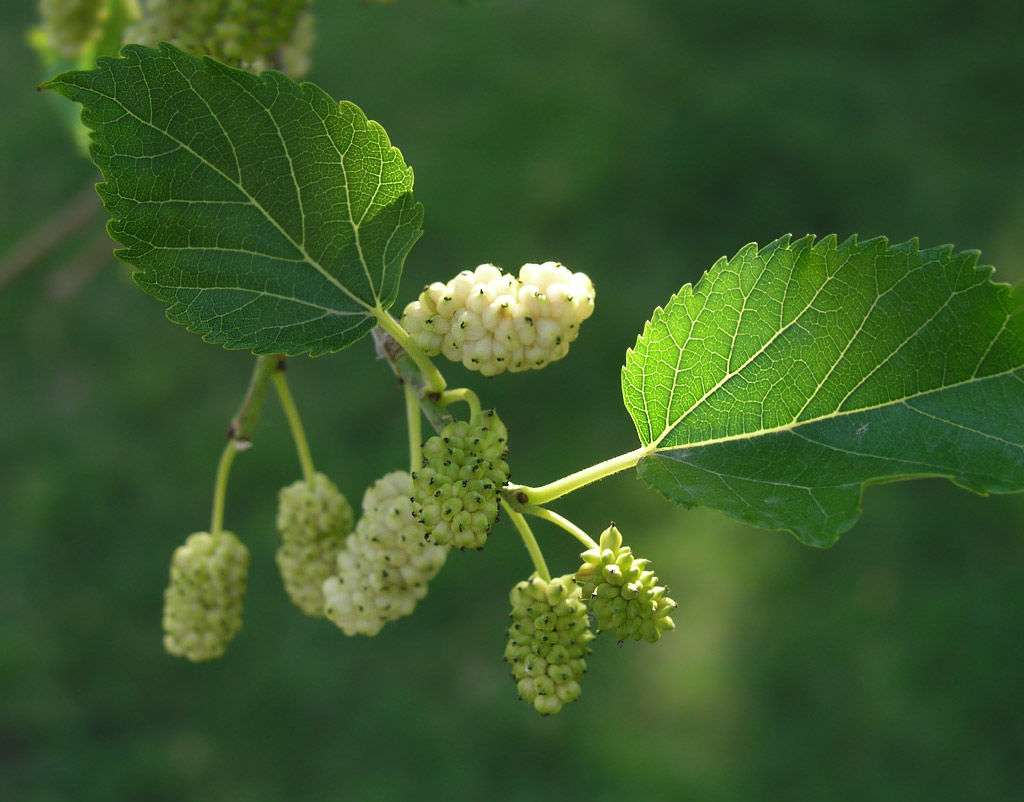
This tree has also been planted in various areas for erosion control and windbreaks. White mulberry is usually dioecious (separate male and female trees), but sometimes is monoecious. Small yellowish-green flowers in drooping catkins bloom in spring (March-April). Fertilized flowers on female trees are followed by sweet, edible blackberry-like fruits (cylindrical drupes to 1" long) that mature in June. Fruits ripen to white or pink, but sometimes to darker reds or purple-blacks. Fruits are loved by birds.
Best suited for zones 4-9.

It is widely cultivated for its edible pods, and as an ornamental tree in gardens. The ripe, dried pod is often ground to carob powder, which is used to replace cocoa powder. Carob bars, an alternative to chocolate bars, are often available in health-food stores.
Carob consumed by humans is the dried (and sometimes roasted) pod. The pod consists of two main parts: the pulp accounts for 90% and the seeds for 10% of the pod weight.
Carob is mildly sweet and is used in powdered, chip or syrup form as an ingredient in cakes and cookies, and as a substitute for chocolate. Carob bars are widely available in health food stores. A traditional sweet, eaten during Lent and Good Friday, is also made from carob pods in Malta. Dried carob fruit is traditionally eaten on the Jewish holiday of Tu Bishvat.
While chocolate contains levels of theobromine which are toxic to some mammals, carob contains significantly less caffeine and theobromine, and is therefore used to make chocolate-flavored treats for dogs.
Carob pod meal is used as an energy-rich feed for livestock, particularly for ruminants, though its high tannin content may limit its use. Carob pods were mainly used as animal fodder in the Maltese Islands, apart from times of famine or war when they formed part of the diet of many Maltese. In the Iberian Peninsula, carob pods were used to feed donkeys.
The carob tree is native to the Mediterranean region, including Southern Europe, Northern Africa, the larger Mediterranean islands; to the Levant and Middle-East of Western Asia into Iran; and to the Canary Islands and Macaronesia.
Carob trees may be grown in USDA zones 9-11.
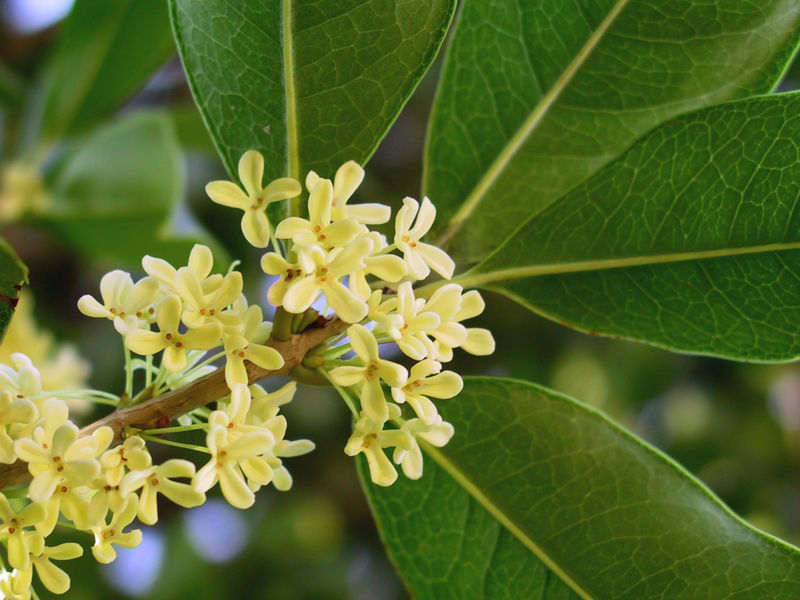
Tea olive is a large upright shrub that can reach 20 ft (6.1 m) tall and 6-8 ft (1.8-2.4 m) wide, but is usually seen in landscapes at 6-10 ft (1.8-3.1 m) high. The opposite leaves are a dark, shiny green and the edges may be finely toothed or smooth with both types present on the same individual. As the plant matures, most of the foliage is held at the outermost ends of the stems, but the plant retains a handsome appearance despite the legginess. In autumn, winter and early spring white flowers cover the shrub. It also blooms sporadically throughout the summer.
Individually the blossoms are small and inconspicuous, but the fragrance is powerful and exquisite.
Tea olive is rather slow growing and is usually quite long lived.
Tea olive prefers reasonably good soil, but is adaptable except in the poorest, sandy soil. May be pruned to maintain size and encourage branching, but thrives equally well with neglect. Tea olives are sometimes attacked by scale insects, but usually only when growing conditions are poor.
Light: Sun to partial shade; morning sun with afternoon shade, or high, shifting shade is ideal.
Plant tea olives where their lovely fragrance can be enjoyed! Situate a tea olive wherever there is foot traffic near windows or doors and in outdoor sitting areas. Incorporate tea olive into foundation plantings at the corners or use as an accent between windows. A row of tea olive makes a very attractive hedge or screen. In areas where it is tender, grow tea olive as a container specimen so it can be protected indoors in winter.
USDA Zones 8 to 10.
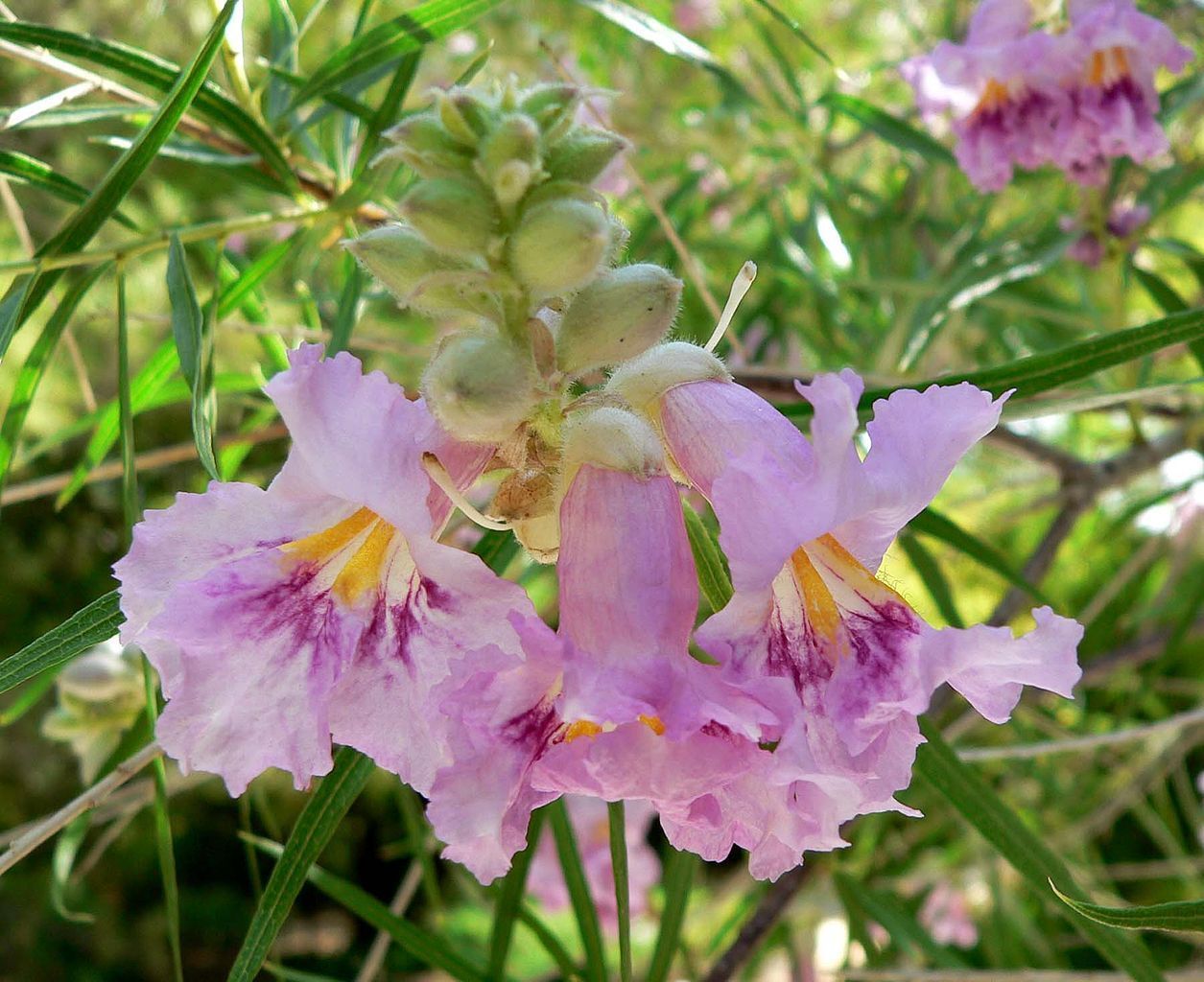
The Penstemon like flowers are fragrant, pink to lavender. They appear in May and keep coming until September or frost. Likes moderate water and sun. Does best inland and in desert.
This is a great plant for a bird garden, rock garden, xeriscape or lawn specimen.
Best suited for zones 6-10.

Bronze loquat has a neat habit and compact growth making it an ideal specimen or patio tree, or even street tree since it can be grown beneath power lines. It also blends well into a shrub border and can be espaliered against a south facing wall.
Bronze loquat only reaches a height of 15 to 20 feet with a 10 to 15 foot spread if grown in full sun. Its chief asset is the large, heavily textured, evergreen leaves, which, when emerging in spring, are bright red-bronze and burnished copper. And they maintain this color for a considerable period of time before eventually turning a rich dark green for summer.
In addition to the striking foliar display there are small, white flowers, produced on showy panicles in spring. The flowers are also fragrant and will perfume your garden for weeks. These are followed by small fruits, similar to the Japanese loquat but not as palatable, though the wildlife will appreciate them.
Bronze loquat should be well watered until established, but can then survive periodic droughts. It should not be over fertilized since this may increase the risk of fire blight. Other than that it is quite healthy and maintenance free. It is a great choice for warm winter areas or the conservatory.
Zones 9-11.
Recent research suggests that elemol, another component extractable from the fruit,
shows promise as a mosquito repellent with similar activity to DEET in contact and
residual repellency.
Notes:The Osage-orange is commonly used as a tree row windbreak in prairie states,
which gives it one of its colloquial names, "hedge apple". It was one of the primary trees
used in President Franklin Delano Roosevelt's "Great Plains Shelterbelt" WPA project,
which was launched in 1934 as an ambitious plan to modify weather and prevent soil
erosion in the Great Plains states, and by 1942 resulted in the planting of 30,233
shelterbelts containing 220 million trees that stretched for 18,600 miles (29,900 km).
The sharp-thorned trees were also planted as cattle-deterring hedges before the
introduction of barbed wire and afterward became an important source of fence posts.
The heavy, close-grained yellow-orange wood is very dense and is prized for tool
handles, treenails, fence posts, electrical insulators, and other applications requiring a
strong dimensionally stable wood that withstands rot. Straight-grained osage timber (most
is knotty and twisted) makes very good bows. In Arkansas, in the early 19th century, a
good Osage bow was worth a horse and a blanket. Additionally, a yellow-orange dye can
be extracted from the wood, which can be used as a substitute for fustic and aniline dyes.
When dried, the wood has the highest BTU content of any wood, and burns long and hot.
Today, the fruit is sometimes used to deter spiders, cockroaches, boxelder bugs, crickets,
fleas, and other arthropods.
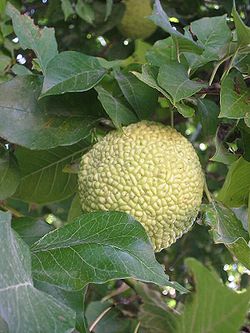
Leaves turn bright yellow in fall, thorny branches, bears inedible round fruit 3-5" in
diameter. The fruit is prized for it's ability to repel insects and spiders when scattered
around home foundations. The crushed fruits of this plant are said to attract and kill
cockroaches. Can be raised as container plant in northern states.
The wood is sought after for recurve bow making. Both male and female plants are
needed to produce fruit. The ratio of male/female plants the seeds produce is up to mother
nature, but a pack of 10 seeds always produces a mix of male/female plants in all of our
previous field trials. Can be grown in zones 4-9.
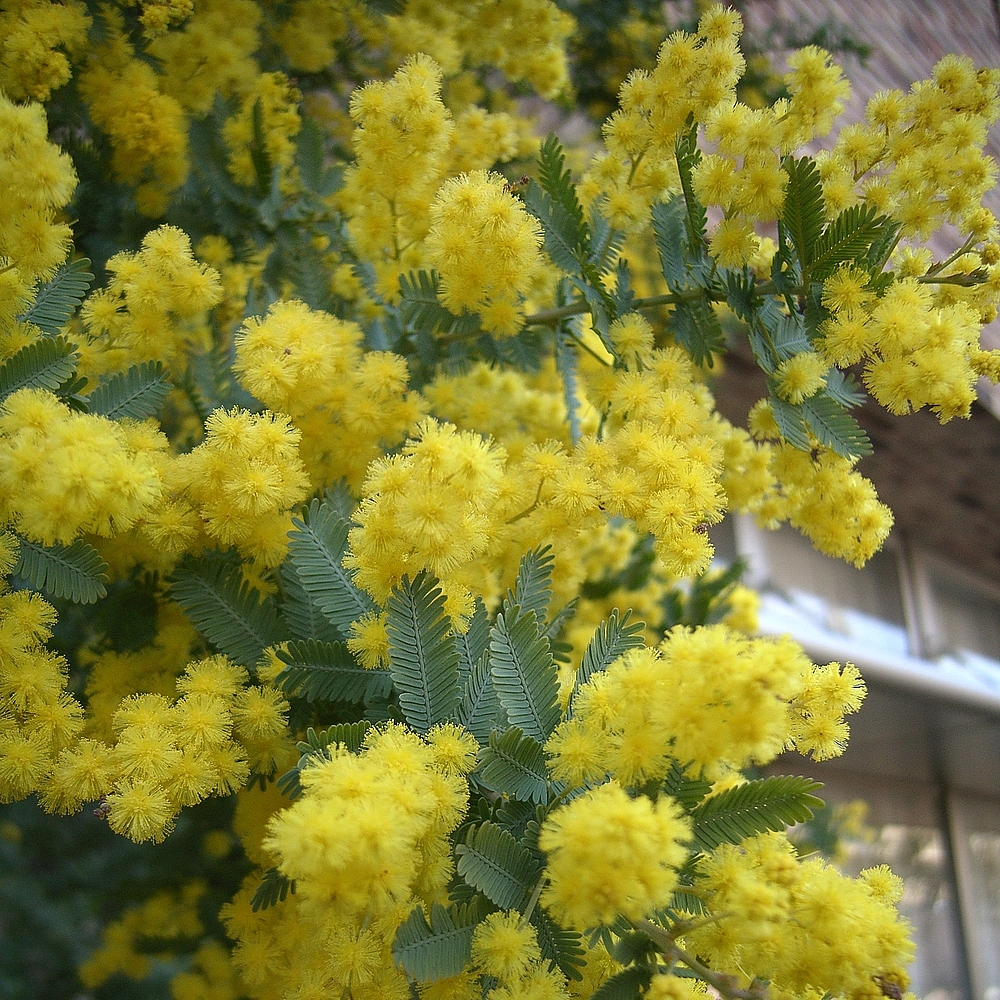
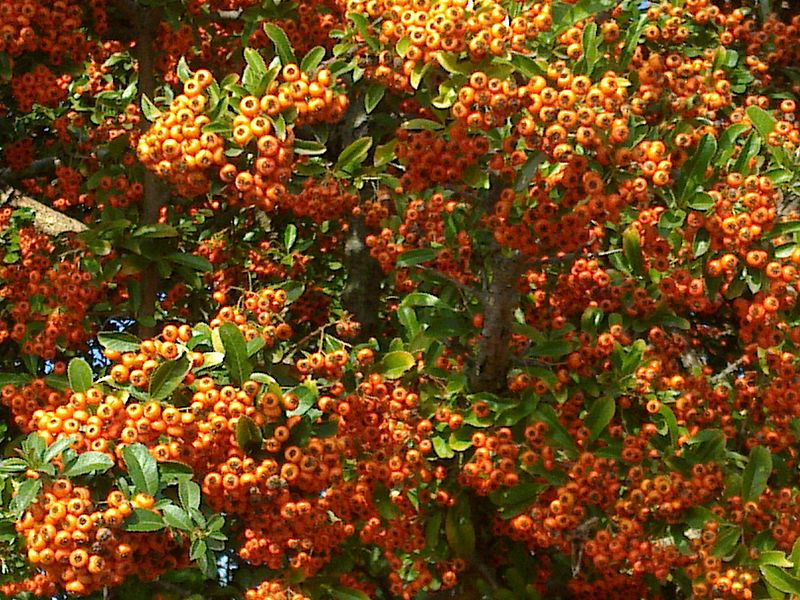
Light: Full sun preferred but will grow in partial to fairly
heavy shade. Flowering and fruiting will not be as heavy.
Moisture: Moist to very dry, well drained soil. Hardiness:
Zones 5 - 9.
Usage: Pyracantha is often used as an espalier. Held flat
against a wall, it can be shaped quite creatively. Because of
its fast growth rate, sprawling, spreading habit, and ease of
care, it can be used on slopes to great advantage requiring
little maintenance or care. The wide-reaching stems may be
pruned back as needed during warm weather as the shrub blooms
on old wood. Even consider using it as an informal hedge! This
will require some trimming and shaping for the first few years
but the effort will produce impressively beautiful and secure
(thorny) hedges.

Serving gardeners since 1992
State of Mississippi Seedmen's Permit #C-391, Ohio 90152, Minnesota 20086777


,ML_fri05sep2014-1016h.jpg)


.jpg)

.jpg)

.jpg)


.jpg)


.jpg)


